True Monotheism: Who Stands Between You and God? —Bashir Lucas Samson Lukman
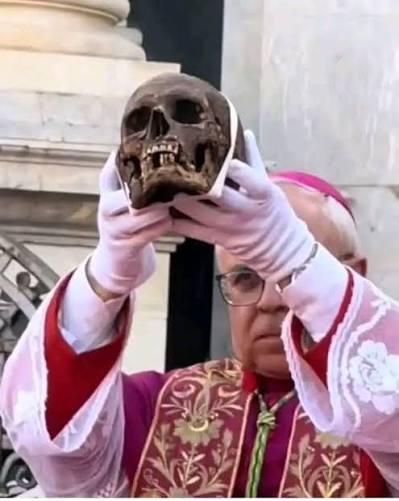
I saw the images coming out of Catania, Sicily. Archbishop Luigi Renna, the Metropolitan Archbishop of Catania,…
I saw the images coming out of Catania, Sicily.
Archbishop Luigi Renna, the Metropolitan Archbishop of Catania, was holding the skull of Saint Agatha before it was returned to its ornate reliquary. The ceremony took place on August 17, 2026, during celebrations marking 900 years since the return of Saint Agatha’s relics to Catania.
And I found myself asking a very simple question:
What exactly is monotheism?
Because almost every major religious tradition has a way of describing itself as monotheistic.
Christians say they believe in one God.
Some religious traditions speak of a supreme God while also having gods, goddesses, spirits or divine beings through whom people approach that supreme reality.
And Catholics will tell you that they do not worship saints or relics. They distinguish between latria, the worship owed to God alone, and veneration, which they say is given to saints and their relics.
Fair enough.
But Islam asks a more fundamental question:
Why should anyone be religiously venerating a created being or the remains of a created being in the first place?
That is where the Islamic concept of Tawḥīd becomes radically different.
Monotheism is not simply counting Gods
The common definition of monotheism is straightforward:
“There is one God.”
But that definition is incomplete.
The real question is:
Who do you worship?
Because a person can believe that there is one supreme Creator and still believe that other beings should be approached, invoked, venerated or treated as intermediaries between humanity and that Creator.
The Qur’an tells us that this very argument existed among the Arabs who worshipped other beings. They claimed that they only worshipped them in order to bring themselves closer to Allah.
In other words:
“We know Allah exists. We are just approaching Him through these intermediaries.”
Islam rejected the premise.
You don’t need them.
Allah does not need them.
And you don’t need them to reach Allah.
This is where Islam is different
The Islamic concept is astonishingly simple:
Allah alone is God. Therefore, Allah alone is worshipped.
Not Allah and saints.
Not Allah and angels.
Not Allah and prophets.
Not Allah and gods.
Not Allah and goddesses.
Not Allah and sacred objects.
Not Allah with a human intermediary standing between the believer and his Creator.
The Qur’an says:
“And your Lord has decreed that you worship none but Him.”
That is Tawḥīd.
And this is why Islam does not merely tell you that there is one God.
It tells you that nothing else deserves the religious devotion that belongs to God.
But Catholics don’t say they worship the saints
I know.
And this is where the discussion should be intellectually honest.
Catholic theology does not officially teach that Saint Agatha is God.
A Catholic can look at the skull of Saint Agatha and say:
“We are not worshipping this skull. We are venerating the saint whom it represents.”
But the Islamic objection goes deeper than whether Catholic theology uses the word worship.
Islam asks:
Why should the remains of a human being become a sacred object of religious veneration at all?
Why should a skull be publicly presented to crowds as a religious relic?
Why should the remains of a dead person be incorporated into an elaborate object of devotion?
And perhaps most importantly:
What prevents this kind of religious reverence from gradually crossing the boundary between honoring the righteous and attributing sacred significance to the created?
Islam’s answer is to remove the problem at its root.
Honor people.
Love the righteous.
Learn from the prophets.
Respect the scholars.
But worship Allah.
Islam even protects Muhammad ﷺ from this
This is one of the things I find most remarkable about Islam.
The religion that claims Muhammad ﷺ is the final Messenger does not permit Muslims to turn Muhammad into God.
In fact, Muhammad ﷺ himself warned his followers against exaggerating his status.
The Prophet ﷺ said:
“Do not exaggerate in praising me as the Christians praised the son of Mary.”
Then he gave the alternative:
“I am only a Slave. So, call me the Slave of Allah and His Apostle.”
This narration is recorded in Sahih al-Bukhari 3445.
Think about that.
The Prophet of Islam is telling his followers:
Do not make me what Christians made Jesus.
Don’t turn me into God.
Don’t cross the boundary between Creator and creation.
I am a servant of Allah.
I am His Messenger.
That distinction is fundamental.
Even the Black Stone is not allowed to become a god
And this is where Muslims sometimes get an interesting question from Christians and atheists:
“Muslims kiss the Black Stone. Isn’t that idol worship?”
No.
And the reason is not hidden.
We have the statement of Umar ibn al-Khattab.
When Umar approached the Black Stone, he kissed it and said:
“I know that you are a stone and can neither benefit nor harm.”
He then explained that if he had not seen the Messenger of Allah ﷺ kiss it, he would not have kissed it. Sahih al-Bukhari 1597 records the narration.
This is actually one of the clearest demonstrations of the Islamic distinction between obedience to God and worship of an object.
Umar knew exactly what was in front of him.
A stone.
Not a god.
Not a goddess.
Not a supernatural being.
Not an object possessing independent power.
A stone.
He kissed it because the Messenger of Allah ﷺ had done so as part of the prescribed ritual.
That is completely different from believing that the object itself possesses divine power.
And Umar made sure nobody misunderstood the distinction.
This is the safeguard Islam built into worship
The genius of Tawḥīd is not merely that Islam says:
“There is one God.”
It is that Islam constantly tears down the things human beings tend to put between themselves and God.
You cannot say:
“I need this saint to get to God.”
No.
Call upon Allah.
You cannot say:
“I need this prophet to hear my prayer.”
No.
Call upon Allah.
You cannot say:
“I need this sacred object to give me divine help.”
No.
Allah is sufficient.
You cannot say:
“I need a divine incarnation because God is too distant.”
No.
Allah is near.
You cannot say:
“I need a goddess or lesser deity to approach the supreme God.”
No.
There is only one God worthy of worship.
This is why the Qur’an says:
“And the places of worship are for Allah, so do not invoke anyone along with Allah.”
(Qur’an 72:18)
Then there is Christianity
And here we arrive at another major question.
Protestants famously broke away from Catholicism over centuries of theological and ecclesiastical disputes.
Many Protestants rejected Catholic practices surrounding saints, relics, images and other traditions.
But mainstream Protestant Christianity still maintains the doctrine of the Trinity and the divinity of Jesus.
And from the Islamic perspective, this creates another problem.
Because again, Islam is not asking:
“How many gods do you say you have?”
It is asking:
Who is God?
If Jesus is God, and the Father is God, and the Holy Spirit is God, while all three are said to be distinct persons yet one God, Islam does not accept this as the pure, uncompromised monotheism taught by the prophets.
The Qur’an’s description is much simpler:
“Say: He is Allah, One.”
One.
Not one God composed of three persons.
Not God incarnate as a human being.
Not God having a divine son.
Allah.
One.
The problem with intermediaries
And this is not only a Catholic problem.
It is a human problem.
Human beings have always been tempted to place something between themselves and God.
A statue.
A saint.
A prophet.
An ancestor.
A spirit.
A deity.
A goddess.
A sacred object.
A priest.
A spiritual master.
Sometimes the intermediary is called a god.
Sometimes it is called a saint.
Sometimes it is called an incarnation.
Sometimes it is merely called a “means of approaching God.”
But Islam asks:
Why?
Why put something between yourself and the One who created you?
If Allah created you, knows you, hears you and has commanded you to call upon Him, why should another created being become your religious intermediary?
This is the simplicity of Islam.
True monotheism removes the middleman
This is what I mean when I say that Islam is pristine monotheism.
It is not because Muslims are the only people who have ever used the word “one God.”
They are not.
It is because Islam takes God’s oneness to its logical conclusion.
If God is One, worship Him alone.
If God is the Creator, do not worship creation.
If God alone possesses ultimate power, do not invoke other beings as divine powers.
If God hears you, call upon Him.
If God forgives, ask Him for forgiveness.
If God gives, ask Him.
If God is the One who can ultimately help you, seek His help.
There is no need to manufacture a religious middleman.
The human tendency to make the sacred visible
Perhaps this is one reason religious objects become so powerful.
Human beings like something tangible.
Something they can see.
Something they can touch.
Something they can kiss.
Something they can carry.
Something they can place in a beautiful shrine.
Something they can associate with holiness.
But Islam deliberately redirects the believer away from this tendency.
You cannot see Allah in this world.
You cannot contain Allah in a statue.
You cannot put Allah inside a box.
You cannot preserve Allah inside a relic.
You cannot build Allah a human body.
You cannot turn a stone into Allah.
Allah is Allah.
Creation is creation.
And the two must never be confused.
This is why Tawḥīd is more than “belief in one God”
The real question is not:
“Do you believe there is one supreme God?”
The real question is:
“Do you reserve worship exclusively for Him?”
That is the dividing line.
Because someone can believe in a supreme God while worshipping other beings.
Someone can believe in one God while praying through intermediaries.
Someone can believe in one God while elevating a human being to divine status.
Someone can believe in one God while surrounding that belief with sacred beings and objects.
Islam strips all of this away.
It says:
La ilaha illa Allah.
There is no deity worthy of worship except Allah.
Not Allah plus Jesus.
Not Allah plus Mary.
Not Allah plus saints.
Not Allah plus angels.
Not Allah plus gods and goddesses.
Not Allah plus relics.
La ilaha illa Allah.
One God. No intermediary.
This is what makes the Islamic concept of Tawḥīd so profound.
The Muslim does not need to find a saint before calling upon God.
He does not need to find a relic.
He does not need to find a divine incarnation.
He does not need to find a goddess.
He does not need to find a prophet to carry his prayer.
He simply raises his hands.
And calls upon Allah.
That is the relationship Islam gives humanity.
Direct.
Uncomplicated.
Unshared.
The Creator on one side.
The creation on the other.
And nothing in creation is allowed to steal what belongs exclusively to the Creator.
That is true monotheism.
That is Tawḥīd.
Allah alone.