Refuting David J. Harris Jr.: Are Iranians Throwing Qur’ans into Rivers as Islam ‘Collapses’?
By KnowIslam Project Introduction: When Millions See a Lie A lie can travel around the world before…
By KnowIslam Project
Introduction: When Millions See a Lie
A lie can travel around the world before the truth has finished putting on its shoes.
That observation has never been more relevant than in the age of social media.
Recently, conservative commentator David J. Harris Jr., whose Facebook page reaches millions of followers, published a post claiming:
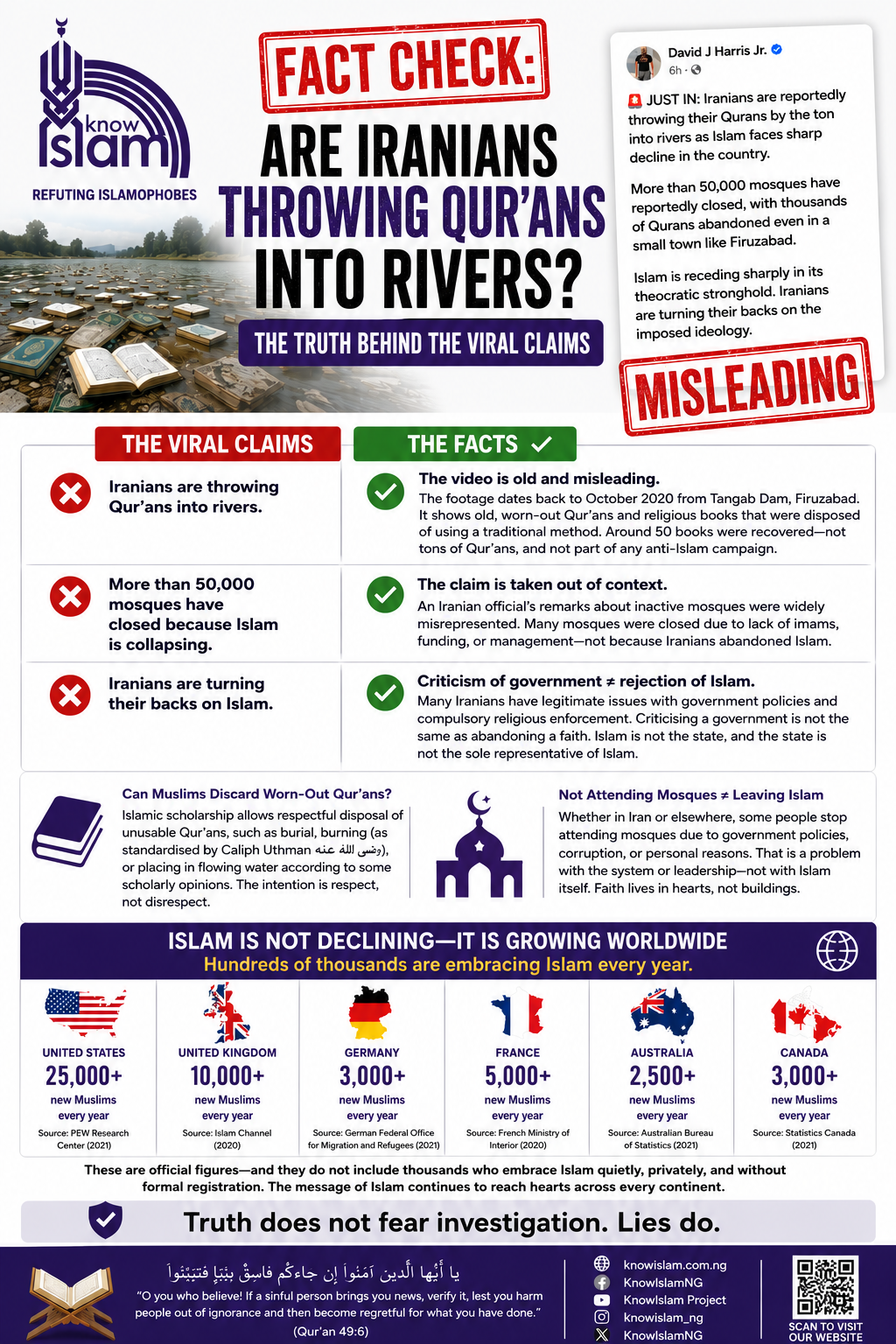
“JUST IN: Iranians are reportedly throwing their Qurans by the ton into rivers as Islam faces sharp decline in the country.”
He continued:
“More than 50,000 mosques have reportedly closed…”
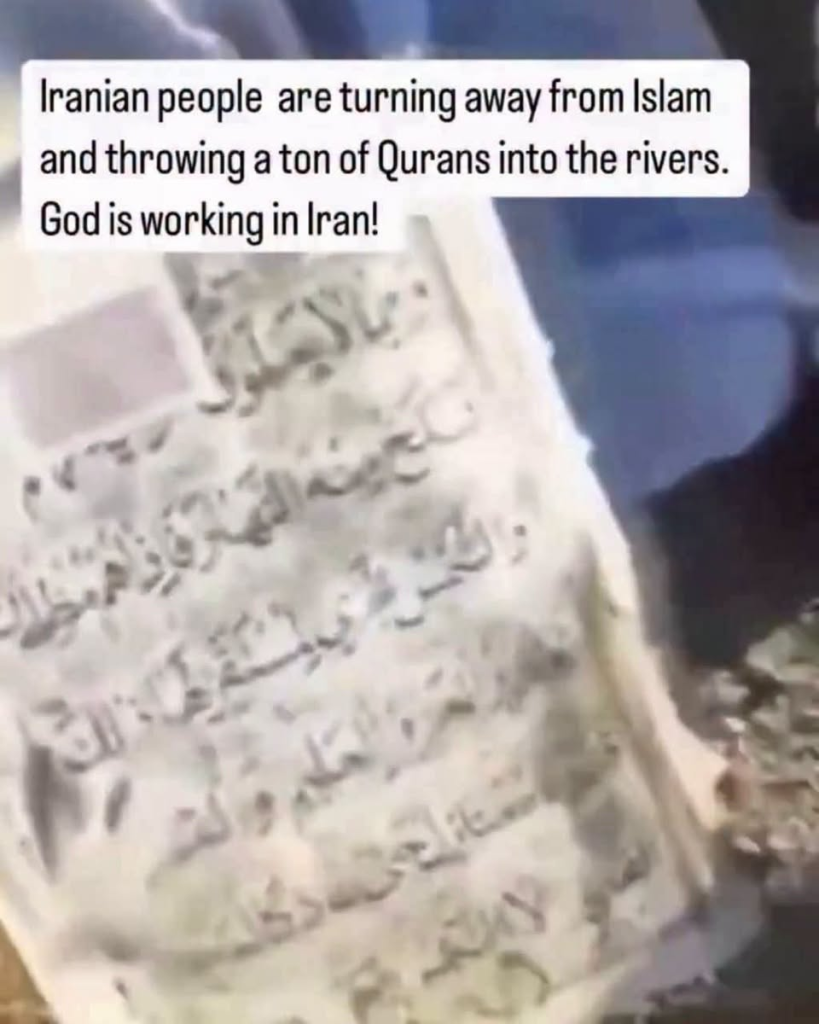
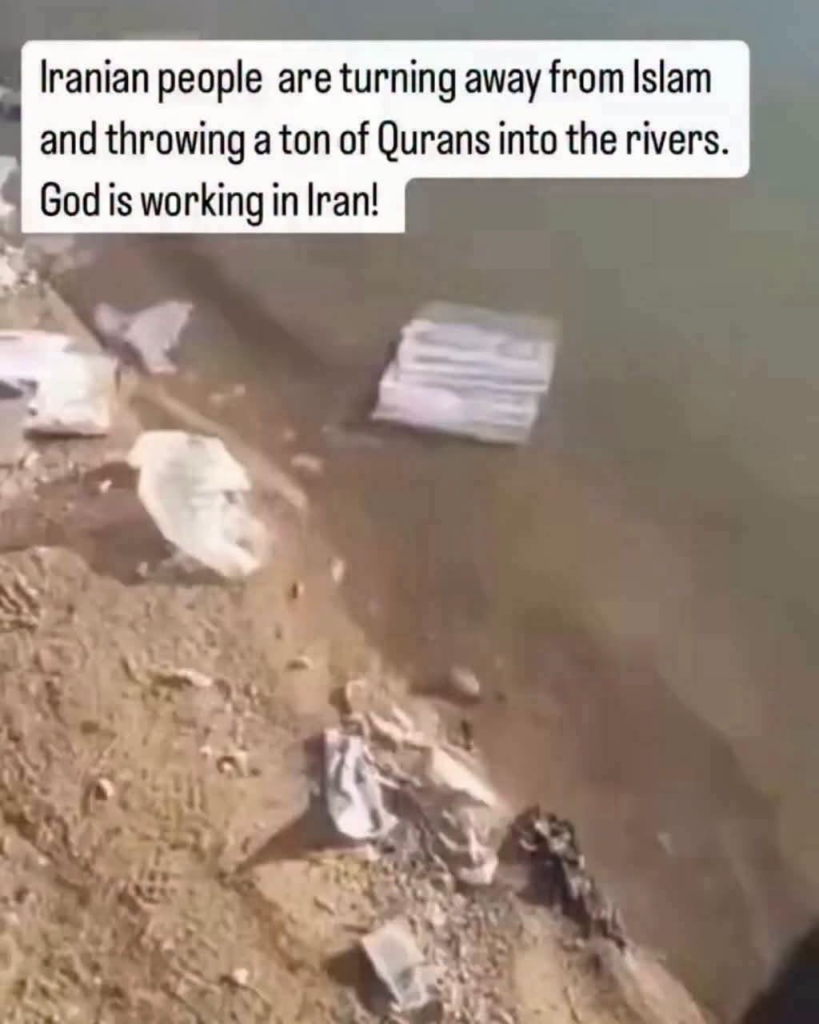
The post was accompanied by photographs and video clips purporting to show Qur’ans floating in rivers and abandoned on riverbanks.
Within hours, the post had attracted thousands of shares.
For many readers, the conclusion was obvious:
“Islam is collapsing in Iran.”
But there is one problem.
The evidence does not support the claim.
Not even close.
This article is not written to defend the Iranian government.
Governments can be criticised.
Policies can be challenged.
Religious authorities can be questioned.
None of that gives anyone the right to fabricate evidence.
Truth matters—even when discussing people we disagree with.
Claim One: “JUST IN”
The first deception appears before the article even begins.
David Harris labels the story:
“JUST IN.”
That wording tells readers something happened recently.
It creates urgency.
It encourages people to share immediately instead of investigating.
Yet reverse-image investigations show that the video being circulated did not originate in 2025 or 2026.
The footage has been online since October 2020.
It has circulated repeatedly over the years, each time attached to a different narrative.
Calling a six-year-old video “breaking news” is misleading.
The very first sentence of the viral post already fails the fact-check.
Claim Two: “Iranians Are Throwing Qur’ans into Rivers”
This is the emotional centre of the story.
The accompanying images are intended to create outrage.
Readers naturally conclude:
“The Iranian people have become so disgusted with Islam that they are dumping the Qur’an into rivers.”
But does the evidence actually demonstrate that?
No.
The video merely shows damaged Qur’ans and religious books near water.
It does not show:
- who placed them there,
- when they were placed there,
- why they were placed there,
- whether they floated there from somewhere else,
- or whether they represent a nationwide trend.
Those conclusions are simply inserted by the narrator.
In journalism, this is called assertion without evidence.
A video is evidence of what it depicts—not of every story someone later attaches to it.
What Actually Happened?
According to reports published when the incident occurred, the books were discovered near Tangab Dam in Firuzabad, Iran.
Local religious authorities investigated.
Their conclusion was significantly different from what social media now claims.
They reported that the books consisted largely of old, worn-out copies of the Qur’an and prayer books that had been disposed of using a traditional method practiced in some Muslim communities.
Water currents later carried many of them toward the shoreline.
Officials recovered roughly 50 damaged religious books, not “tons” of newly discarded Qur’ans.
Whether one agrees with this disposal practice is beside the point.
The important issue is that the available evidence does not support the viral claim that Iranians collectively threw Qur’ans into rivers because they were abandoning Islam.
The story changed.
The evidence did not.
Can Muslims Dispose of Worn-Out Qur’ans?
Many people outside the Muslim community assume that every damaged Qur’an must remain permanently stored.
Islamic scholarship says otherwise.
Throughout Islamic history, scholars discussed respectful ways of disposing of worn-out copies of the Qur’an that could no longer be used.
Among the methods mentioned by jurists are:
- burial in a clean place,
- burning respectfully (similar to what Caliph Uthman ibn Affan did when standardising Qur’anic manuscripts),
- or placing them in flowing water where appropriate according to local scholarly opinion.
The purpose has never been disrespect.
The purpose is preserving the dignity of the Qur’an.
Therefore, discovering damaged Qur’ans near water is not automatically evidence of hatred toward Islam.
Intent matters.
Context matters.
Evidence matters.
The Psychology Behind Viral Misinformation
Why do posts like this spread so quickly?
Because they confirm what many readers already want to believe.
Psychologists call this confirmation bias.
When information supports our existing assumptions, we often stop asking questions.
Instead of asking:
“Is this true?”
people ask:
“Does this fit my worldview?”
That is dangerous.
It is dangerous whether the misinformation targets Muslims, Christians, Jews, atheists, or anyone else.
Truth should never become a casualty of ideology.
Would We Accept the Same Standard Against Christianity?
Imagine someone posted photographs of old Bibles found in a landfill.
Now imagine they wrote:
“Millions of Christians are throwing Bibles away because Christianity is collapsing.”
Would responsible people accept that conclusion?
Of course not.
They would ask:
- Where were these Bibles found?
- Who placed them there?
- Why were they there?
- Is there evidence this represents Christians generally?
Those are precisely the questions that should also be asked here.
Consistency is a hallmark of honesty.
Islam Does Not Need Fabricated Enemies
Some critics seem convinced that Islam can only be challenged through exaggeration.
But if someone genuinely believes Islam is false, why invent stories?
Why recycle years-old videos?
Why attach dramatic captions unsupported by evidence?
Truth should be sufficient.
Fabrication only weakens legitimate criticism.
What the Qur’an Says About Verification
Long before the modern concept of fact-checking existed, the Qur’an warned believers against spreading unverified reports.
Allah says:
“O you who believe! If a sinful person brings you news, verify it, lest you harm people out of ignorance and then become regretful for what you have done.”
(Qur’an 49:6)
This principle applies whether the report concerns Muslims or non-Muslims.
Justice requires verification.
Not selective skepticism.
The Verdict
After examining the available evidence, the viral Facebook post cannot support its central claims.
The evidence shows:
- The video is old, not “JUST IN.”
- The footage does not prove Iranians collectively threw Qur’ans into rivers.
- The explanation attached to the video is disputed and inconsistent with reports from the original investigation.
- No credible evidence shows “tons” of Qur’ans were dumped because Iranians abandoned Islam.
In short, the post presents a predetermined conclusion first and then forces old footage to fit it.
That is not journalism.
It is narrative-building.
And narratives built upon weak evidence eventually collapse under the weight of the truth.