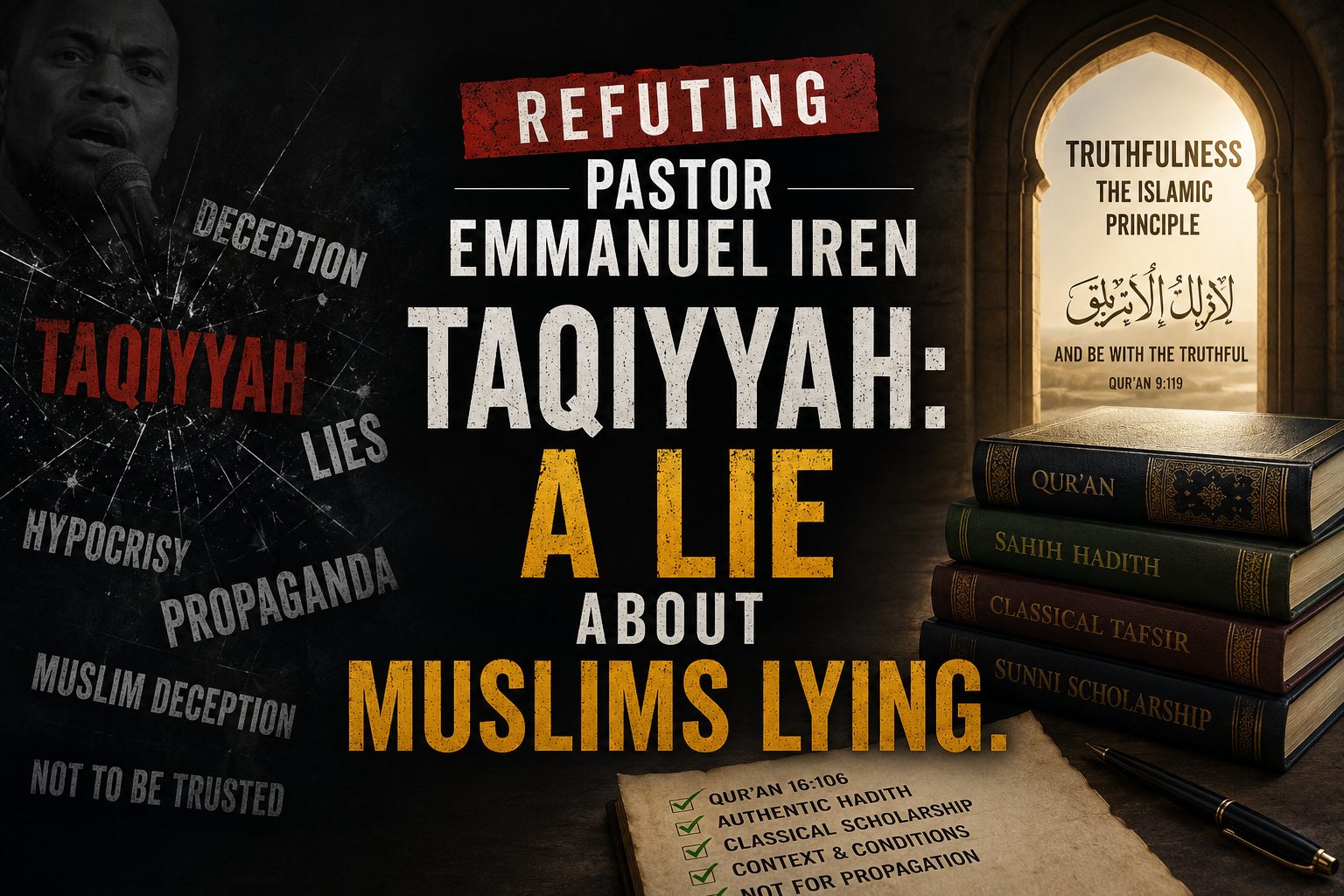
Refuting Pastor Emmanuel Iren —Taqiyyah: A Lie About Muslims Lying By Abdullah Bello
Does Islam permit Muslims to deceive non-Muslims in order to spread the faith? Pastor Emmanuel Iren claims…
Does Islam permit Muslims to deceive non-Muslims in order to spread the faith? Pastor Emmanuel Iren claims that taqiyyah allows Muslims to deceive others when doing so would “propagate the cause of Islam.” We examine the Qur’an, authentic hadith and classical Sunni scholarship to separate Islamic doctrine from a popular anti-Muslim myth.
Are Muslims Allowed to Lie to Non-Muslims?
Examining Taqiyyah and Refuting the Myth of Islamic Deception
“In Islam, there’s something called Taqiyyah. In Islamic doctrine, they are permitted to deceive you if deceiving you would propagate the cause of Islam.” — Emmanuel Iren
Emmanuel Iren is a popular Nigerian pastor with a considerable following, particularly among young Christians. Given the influence he commands, one would expect a degree of care before making categorical statements about a theological tradition other than his own.
Unfortunately, the statement quoted above displays no such care.
He accuses Muslims of religiously sanctioned deception while standing before a congregation and presenting a gross distortion of Islamic teaching as doctrine.
He is lying about lying.
The irony.
The claim that Islam permits Muslims to deceive non-Muslims in order to propagate the faith has been a fixture of anti-Islamic polemics for years. Social media has given the allegation a new lease of life. Today, “taqiyyah” has become one of the favourite words of people who know remarkably little about Islamic theology but remain remarkably confident when speaking about it.
The effect of the accusation is obvious.
If Islam can be portrayed as a religion that sanctions deception, Muslims can then be painted as inherently dishonest. Anything a Muslim says about his religion may be dismissed before it is even considered. His explanations become lies. His denials become lies. His clarifications become lies.
And, conveniently, the critic never has to seriously engage with Islam itself.
But does Islam actually teach Muslims to lie to non-Muslims in order to spread the faith?
No.
And it does not take rocket science to demonstrate this.
God says:
“They wish to extinguish Allah’s light with their mouths, but Allah will certainly perfect His light, even to the dismay of the disbelievers.”
Qur’an 61:8
Before examining taqiyyah itself, however, we must begin with something more fundamental.
What does Islam actually teach about truthfulness?
The Islamic Ethic of Truthfulness
Truthfulness is an integral part of the Islamic faith. It is not treated as a secondary virtue or an optional ornament of good character. It lies at the heart of the moral identity of the believer.
God says:
“O believers! Be mindful of Allah and be with the truthful.”
Qur’an 9:119
Commenting on this verse, Ibn Kathir explains:
“Adhere to and always say the truth so that you become among its people and be saved from destruction. Allah will make a way for you out of your concerns and a refuge.”
[1]
The Qur’an repeatedly returns to this ethic.
God says:
“Do not mix truth with falsehood or hide the truth knowingly.”
Qur’an 2:42
And:
“O believers! Stand firm for justice as witnesses for Allah even if it is against yourselves, your parents, or close relatives.”
Qur’an 4:135
Consider the moral demand of the latter verse.
A Muslim is commanded to uphold justice even when the truth weighs against himself. Even when it implicates his parents. Even when it affects those closest to him.
Yet we are expected to believe that the same religion quietly establishes deception as a method of propagation.
The obligation of truthfulness is no less evident in the Sunnah.
Abu Hurayrah reported that the Prophet ﷺ said:
“The signs of a hypocrite are three: whenever he speaks, he tells a lie; whenever he promises, he breaks his promise; and whenever he is entrusted, he betrays the trust.”
Sahih al-Bukhari, no. 33. [2]
The Prophet ﷺ also said:
“Truthfulness leads to righteousness, and righteousness leads to Paradise… Falsehood leads to wickedness, and wickedness leads to the Fire.”
Sahih al-Bukhari, no. 6094; Sahih Muslim, no. 2607. [3]
This is not ambiguous.
Lying is associated with hypocrisy and wickedness.
Truthfulness is associated with righteousness and Paradise.
The Prophet Muhammad ﷺ himself was known for his trustworthiness even before revelation. His message did not emerge from the mouth of a man notorious for deceit.
At this point, we must ask whether the allegation against Islam holds any water at all.
We are being asked to believe that a religion which repeatedly commands truthfulness, condemns falsehood, identifies lying as a characteristic of hypocrisy, and whose Prophet was renowned for his trustworthiness somehow institutionalised deception as a method of spreading itself.
If such a doctrine exists, it should not be difficult to demonstrate from Islam’s primary sources.
If Muslims are permitted to lie to non-Muslims whenever doing so advances Islam, where is the verse?
Where is the hadith?
Where is the recognised Sunni juristic principle?
Where is the chapter in the books of da’wah instructing Muslims to deceive prospective converts?
Where is this supposedly central strategy openly taught to Muslim children and preachers?
One would expect a doctrine allegedly employed by nearly two billion Muslims to be widely known among Muslims themselves.
Yet the reality is quite the opposite.
For an overwhelming number of Muslims, their first encounter with the word taqiyyah is not in the mosque. It is not in a basic book of creed. It is not in a da’wah manual.
It is on the internet.
Usually from someone accusing them of practising it.
So we must ask: how does a doctrine allegedly central to Islamic propagation remain unknown to the overwhelming majority of Muslims?
How does a strategy supposedly employed by Muslims across the world elude the very people accused of practising it?
Perhaps the answer is simple.
Perhaps the popular polemical presentation of taqiyyah bears little resemblance to its actual meaning.
Perhaps they are simply lying about us lying.
What Does Taqiyyah Actually Mean?
A clarification is necessary before proceeding.
This article is primarily concerned with the Sunni tradition, the largest denominational tradition within Islam and the tradition to which I, and the overwhelming majority of Muslims, belong.
In its basic sense, taqiyyah concerns concealing what one truly believes because of fear of harm.
Ibn al-Qayyim described it as a person saying something contrary to what he believes in order to protect himself from a feared harm that would otherwise befall him.
[4]
Notice what is absent from this definition.
There is nothing about propagating Islam.
There is nothing about deceiving potential converts.
There is nothing about lying to Christians in debates.
There is nothing about Muslims being granted a universal licence to deceive non-Muslims.
Within Sunni jurisprudence, the relevant discussion is connected to fear, coercion and necessity.
Al-Qurtubi, commenting on Qur’an 3:28, states:
“Taqiyyah is not permissible except with fear of being killed, having a limb severed, or suffering severe harm.”
[5]
Again, read the conditions.
Fear of death.
Severe bodily harm.
Grave injury.
Not da’wah.
Not religious propaganda.
Not “propagating the cause of Islam.”
The principle is comparable to other concessions recognised in Islamic law.
A starving person facing death may eat food ordinarily prohibited to him if that is necessary to preserve his life. The prohibition has not suddenly become meaningless. Pork has not become generally permissible. A specific concession exists because a specific necessity exists.
Likewise, a believer facing genuine coercion may be excused for uttering words he does not truly believe while his heart remains firm upon faith.
The concession exists because the necessity exists.
Remove the necessity and you cannot simply continue invoking the concession as a general licence.
The clearest Qur’anic basis for this discussion is God’s statement:
“Whoever disbelieves in Allah after their belief—not those who are forced while their hearts are firm in faith, but those who embrace disbelief wholeheartedly—they will be condemned by Allah and suffer a tremendous punishment.”
Qur’an 16:106
Read the verse again.
It does not say:
“Except for the one who wishes to propagate Islam.”
It does not say:
“Except for the Muslim debating a Christian.”
It does not say:
“Except for the Muslim who wants to gain converts.”
The operative word is compelled.
Forced.
Coerced.
This is the Qur’anic text around which the Sunni discussion revolves.
Ammar ibn Yasir and the Context of Coercion
Classical exegetical literature famously connects Qur’an 16:106 with the persecution of Ammar ibn Yasir.
Ammar and his family suffered severely because of their acceptance of Islam. His mother, Sumayyah bint Khayyat, is remembered among the earliest martyrs of Islam.
According to the reports discussed by the classical exegetes, Ammar was subjected to severe persecution until he uttered words demanded by his persecutors. His heart, however, remained firm upon faith.
The reports state that the Prophet ﷺ asked him about the condition of his heart and Ammar replied that it remained secure in faith. The well-known report further relates that he was told that if his persecutors returned to such coercion, he could respond likewise.
[6]
Whether one is discussing the Qur’anic text itself or the reports concerning Ammar, the context is unmistakable.
Persecution.
Coercion.
Grave harm.
Survival.
Not evangelism.
Not da’wah.
Not religious propaganda.
In fact, the claim that taqiyyah exists to spread Islam collapses under the weight of its own absurdity.
Why would a Muslim lie about not being Muslim in order to spread Islam?
How exactly does concealing one’s faith from a persecutor become a method of inviting people to that faith?
The allegation makes little sense once the actual context is explained.
A Concession Under Coercion Is Not a General Licence to Lie
This distinction is important.
Islamic law contains concessions for extraordinary circumstances. The existence of a concession does not abolish the general rule.
If a starving person may consume prohibited food to preserve his life, it would be grossly misleading to announce:
“Islam permits Muslims to eat pork.”
Technically, one has taken a real ruling and simply amputated all of its conditions.
The necessity is removed.
The exceptional circumstance is removed.
The legal qualification is removed.
What remains is a distortion.
That is precisely what happens in the popular polemic surrounding taqiyyah.
A concession relating to coercion and grave harm is stripped of its legal conditions and historical context. It is then repackaged as:
“Muslims are allowed to lie to non-Muslims.”
And sometimes, as Emmanuel Iren claimed:
“They are permitted to deceive you if deceiving you would propagate the cause of Islam.”
Where did the part about propagating Islam come from?
It is not contained in Qur’an 16:106.
It is not the circumstance discussed in the reports concerning Ammar ibn Yasir.
It is not al-Qurtubi’s stated condition of fear of death, severance of a limb or severe harm.
It is simply inserted into the definition and then presented to an unsuspecting audience as “Islamic doctrine.”
That is not scholarship.
That is not careful theological engagement.
It is a distortion.
The Higher Ideal of Steadfastness
There is another aspect of this discussion that critics conveniently ignore.
Although Islamic law recognises the concession for one genuinely compelled to utter words of disbelief, Sunni scholars also discussed the virtue of remaining steadfast under such persecution.
In his commentary on Sahih al-Bukhari, Ibn Hajar quotes Ibn Battal as saying:
“They agreed that whoever is compelled to disbelief and chooses to be killed is greater in reward with Allah than one who chooses the concession.”
[7]
The scope of the statement is important.
The discussion concerns a person compelled to utter disbelief.
It is not a general command that a Muslim must reject every legal concession in every circumstance. It is a specific juristic discussion concerning coercion to disbelief.
And Islamic history contains famous examples of steadfastness under persecution.
Sumayyah bint Khayyat remained firm upon her faith.
Bilal ibn Rabah endured severe persecution while proclaiming:
“Ahad, Ahad.”
“One. One.”
An affirmation of the absolute oneness of God.
Centuries later, Imam Ahmad ibn Hanbal endured imprisonment and flogging during the Mihnah rather than publicly affirm a theological proposition he believed to be false.
Islamic history is filled with men and women remembered for steadfastness under pressure.
This is rather strange behaviour for members of a religion supposedly built upon religious deception.
The jurists recognised the concession available to the genuinely coerced person because human beings differ in their capacity to endure suffering.
God knows human weakness.
He knows the limits of His creation.
The person who breaks under genuine coercion while his heart remains firm in faith is not treated like the person who willingly embraces disbelief.
The concession is mercy.
It is not a command to lie.
God did not command Ammar to seek opportunities for deception. Nor did Islam transform concealment into the ideal response to ordinary disagreement.
Rather, Qur’an 16:106 expressly exempts the person compelled while his heart remains firm upon faith from the condemnation directed at the one who willingly embraces disbelief.
There is a vast difference between saying:
“A persecuted believer may be excused for concealing his faith or uttering words of disbelief under grave coercion.”
And saying:
“Muslims may deceive non-Muslims if deception helps spread Islam.”
One is a discussion of coercion.
The other is an invention.
The Unfalsifiable Accusation
Perhaps the most remarkable feature of the taqiyyah accusation is that, in the hands of the committed polemicist, it is impossible to refute.
If a Muslim tells the truth, he is practising taqiyyah.
If a Muslim denies the accusation, the denial itself is taqiyyah.
If a Muslim explains the actual meaning of the term, the explanation is dismissed as taqiyyah.
If Muslim scholars produce texts condemning lying, those texts are apparently part of the deception.
Every possible response becomes further evidence of the original accusation.
This article itself will undoubtedly be called taqiyyah by someone.
The argument is therefore unfalsifiable.
It operates like this:
Muslims are liars.
“How do you know?”
Because Islam permits them to lie.
“Muslims say Islam does not permit this.”
Of course they say that. They are lying.
“What evidence would prove that they are telling the truth?”
Nothing. Because they are liars.
This is not serious reasoning.
It is circular prejudice dressed in theological vocabulary.
Once a person accepts the premise that Muslims are religiously authorised to deceive him, he no longer has to listen to a Muslim.
That is the real power of the taqiyyah myth.
It creates an intellectual escape route from every discussion about Islam.
The Muslim has already been declared dishonest before he opens his mouth.
So, Are Muslims Allowed to Lie to Non-Muslims?
No.
There is no general Islamic doctrine permitting Muslims to lie to non-Muslims because they are non-Muslims.
There is no Sunni doctrine permitting Muslims to deceive people for the purpose of propagating Islam.
The default Islamic moral command is truthfulness.
Lying is condemned.
Falsehood is condemned.
Betrayal is condemned.
The Prophet ﷺ associated lying with hypocrisy.
He taught that truthfulness leads to righteousness and Paradise, while falsehood leads to wickedness and the Fire.
Islam does, however, recognise the reality of coercion.
The Qur’an expressly exempts the believer who is compelled while his heart remains firm upon faith.
Classical Sunni scholars discussed taqiyyah within the context of fear and grave harm. Al-Qurtubi expressly connected its permissibility to fear of death, severance or severe injury.
That is the discussion.
That is the context.
That is the concession.
To take this narrow concession, remove coercion, remove grave harm, remove Qur’an 16:106, remove the classical juristic conditions, and then announce that:
“Muslims are permitted to deceive you if deceiving you would propagate the cause of Islam”
is not an explanation of Islamic doctrine.
It is a caricature of it.
Taqiyyah is not a Sunni method of propagating Islam.
If Emmanuel Iren or anyone else wishes to maintain that Muslims are doctrinally permitted to deceive non-Muslims in order to propagate Islam, the burden is upon them to produce the evidence.
Not an anti-Muslim website.
Not a recycled apologetics talking point.
Not a definition repeated from one polemicist to another.
Produce the Qur’anic verse.
Produce the authentic hadith.
Produce the recognised Sunni juristic principle that says a Muslim may deceive non-Muslims for the purpose of spreading Islam.
Until then, the accusation remains what it has always been:
A lie about Muslims lying.
And on taqiyyah, God knows best.
References
[1] Ibn Kathir, Tafsir al-Qur’an al-‘Azim, commentary on Qur’an 9:119. Ibn Kathir explains the verse as an instruction to adhere to truth so that one becomes among the truthful and is saved from destruction.
[2] Sahih al-Bukhari, Kitab al-Iman, Hadith no. 33. Narrated by Abu Hurayrah: “The signs of a hypocrite are three…” See also Sahih al-Bukhari, no. 6095.
[3] Sahih al-Bukhari, Kitab al-Adab, Hadith no. 6094; Sahih Muslim, Kitab al-Birr wa’l-Silah wa’l-Adab, Hadith no. 2607. Narrated from ‘Abdullah ibn Mas’ud.
[4] Ibn al-Qayyim, Bada’i al-Fawa’id. The definition attributed to Ibn al-Qayyim describes taqiyyah as saying contrary to one’s belief to ward off a feared harm. The Arabic wording commonly cited is: “التقية أن يقول العبد خلاف ما يعتقده لاتقاء مكروه يقع به لو لم يتكلم.”
[5] Al-Qurtubi, al-Jami’ li-Ahkam al-Qur’an, commentary on Qur’an 3:28: “والتقية لا تحل إلا مع خوف القتل أو القطع أو الإيذاء العظيم” — “Taqiyyah is not permissible except with fear of death, severance, or severe harm.”
[6] See the classical tafsir discussions of Qur’an 16:106 concerning Ammar ibn Yasir. The report of the Prophet ﷺ asking Ammar about the state of his heart and the response that it was firm or tranquil in faith is cited in the exegetical literature in connection with the verse. The fuller wording, including “if they return, then return,” is reported in works including al-Hakim’s al-Mustadrak. The report should be distinguished in citation from hadiths found in Sahih al-Bukhari and Sahih Muslim.
[7] Ibn Hajar al-‘Asqalani, Fath al-Bari bi-Sharh Sahih al-Bukhari, Kitab al-Ikrah, chapter concerning the one who chooses beating, death and humiliation over disbelief. Ibn Hajar quotes Ibn Battal: “أجمعوا على أن من أكره على الكفر واختار القتل أنه أعظم أجراً عند الله ممن اختار الرخصة.”