
A Jesus-Moses Conversation With A Christian — Bashir Lucas Samson Lukman
The books of Deuteronomy 18:18 and John 1:19–21 have been subjects of religious discourse for centuries. While…
The books of Deuteronomy 18:18 and John 1:19–21 have been subjects of religious discourse for centuries. While the former asks who that prophet like unto Moses would be, the latter leaves us with an interesting question: Who was “that Prophet”?
I got talking to a Christian brother who was referred to me because he, in his own words, was “in search of the truth.”
He started off with the need for Muslims to follow the Injeel and Torah; the now popular Christian rhetoric to convince Muslims to follow the Bible, hook, line and sinker. Were Muslims to follow the Old and New Testaments of the Bible, one wonders if that would include the letters of Paul or the extra seven books in the Catholic Bible, making it a total of 73 books against the 66 books in the Protestant Bible.
“Muhammad is said to have been mentioned in the Bible. Do you have any evidence for that?” he asked.
“I wouldn’t say he was mentioned explicitly by name, but we could make an inference from Deuteronomy 18:18 and John 1:19–21. Then we compare how Muhammad fits against whom you think fits (Jesus).”
Deuteronomy 18:18: A Prophet Like Moses
The passage reads:
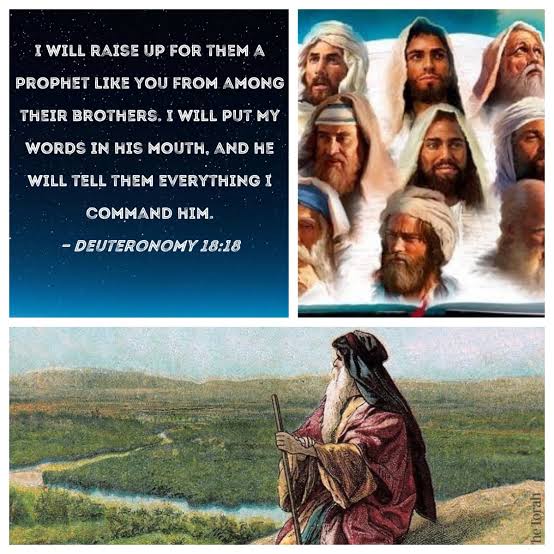
“I will raise them up a Prophet from among their brethren, like unto thee, and will put my words in his mouth; and he shall speak unto them all that I shall command him.” — Deuteronomy 18:18 (KJV).
There are three important elements in this prophecy:
- God would raise a prophet like Moses.
- This prophet would emerge from among the brethren of the Israelites.
- God would put His words in his mouth, and he would communicate everything God commanded him.
Now, the question is simple: Who fits this description?
Christians identify Jesus. Muslims identify Muhammad. But rather than begin with religious allegiance, let us examine the actual similarities between the lives and missions of these men and Moses.
1. The brethren of the Israelites: Who were they?
Deuteronomy 18:18 does not merely say that God would raise a prophet from among the Israelites. It says the prophet would come from among their brethren.
This distinction matters.
The Israelites descended from Isaac, the son of Abraham. Ishmael was Isaac’s brother, and the Ishmaelites descended from him. They were therefore a related people, sharing Abrahamic ancestry with the Israelites.
Muhammad descended from the Ishmaelite line through the Arabs.
Jesus, on the other hand, was an Israelite. He was born among the very people to whom the prophecy was addressed.
The question, therefore, is why the prophecy uses the expression “their brethren” rather than simply saying that God would raise another prophet from among the Israelites.
The Muslim interpretation is that this language points towards a prophet emerging from a related but distinct people: the descendants of Ishmael.
This is particularly significant because the descendants of Ishmael and Isaac were not strangers to one another. They were branches of the same Abrahamic family.
Muhammad’s emergence among the Arabs, therefore, fits a dimension of the prophecy that is often overlooked in Christian discussions.
2. Moses and Muhammad: Two lawgiving prophets
Perhaps the most striking similarity between Moses and Muhammad is their relationship with divine law.
Moses received the Torah, which contained commandments governing the religious, social and communal lives of the Israelites.
Muhammad received the Qur’an, which established commandments governing virtually every aspect of Muslim life, including worship, marriage, inheritance, commerce, family relations and justice.
Both men were not merely spiritual teachers who called people to believe in God. They established religious communities governed by divine legislation.
Consider Jesus.
In Matthew 5:17, Jesus says:
“Think not that I am come to destroy the law, or the prophets: I am not come to destroy, but to fulfil.”
Jesus’ ministry was directed towards the Israelites, and his relationship with the Mosaic Law was fundamentally different from that of Moses.
He did not establish a political community with a comprehensive legal administration comparable to the one Moses established among the Israelites.
Muhammad, however, did.
If the prophecy concerns a prophet who would resemble Moses in the nature and responsibilities of his prophetic mission, Muhammad presents an extraordinarily compelling comparison.
3. Moses and Muhammad were both heads of their communities
Moses was not simply a man who delivered sermons. He confronted Pharaoh, led the Israelites out of Egypt, organised their community, administered justice and governed their affairs.
Muhammad similarly transformed the religious and political landscape of Arabia.
He migrated from Makkah to Madinah, established a community, negotiated treaties, settled disputes, administered justice and led his followers through periods of conflict.
Both men were simultaneously religious leaders and heads of their respective communities.
Now consider Jesus.
Jesus preached, taught, performed miracles and called people towards God. But during his earthly ministry, he did not establish a comparable political administration or govern an independent religious community.
Muhammad’s prophetic career therefore bears a much closer resemblance to the public and governmental responsibilities of Moses.
This is not a minor similarity. It concerns the very nature of their missions.
4. Both Moses and Muhammad received extensive divine revelation
Deuteronomy 18:18 says:
“I will put my words in his mouth; and he shall speak unto them all that I shall command him.”
This is particularly interesting when we examine the Islamic understanding of Muhammad’s revelation.
Muhammad did not claim to be the author of the Qur’an. He consistently maintained that he was receiving revelation from God through the angel Gabriel.
The Qur’an says:
“Nor does he speak from his own inclination. It is not but a revelation revealed.” — Qur’an 53:3–4.
The first revelation received by Muhammad began with the command Iqra (Read or Recite). The Qur’an was subsequently revealed over approximately 23 years, addressing questions of theology, morality, law, worship and the organisation of society.
The parallel with Moses is striking.
Moses received divine commandments and communicated them to his people. Muhammad received divine commandments and communicated them to his people.
Both presented themselves as messengers carrying God’s words rather than independent religious philosophers advancing personal doctrines.
5. Both were married and had children
Moses married Zipporah and had children. Muhammad was also married and had children.
This might appear like an ordinary biographical observation, but it becomes relevant when examining the totality of the comparison.
Moses was a prophet who experienced marriage, family responsibilities, leadership, political challenges and the ordinary obligations of human society.
Muhammad experienced these same dimensions of human life.
Jesus, in mainstream Christian understanding, remained unmarried and had no children.
There is nothing inherently wrong with being unmarried. Prophethood is not determined by marital status. But when the question is which historical figure most closely resembles Moses, these biographical parallels add to the cumulative case for Muhammad.
6. Both experienced natural deaths
Moses died after completing his prophetic mission, as recorded in Deuteronomy 34.
Muhammad also died after completing his mission and establishing Islam across much of Arabia.
The Christian understanding of Jesus’ death is fundamentally different. Christians believe Jesus was crucified, resurrected and ascended to heaven. Muslims reject the claim that Jesus was successfully killed by crucifixion, based on Qur’an 4:157–158.
Once again, the biographies of Moses and Muhammad share a striking pattern.
Both lived as prophets, established communities, delivered divine commandments, led their people and eventually died natural deaths.
When we consider these similarities collectively, it becomes increasingly difficult to dismiss Muhammad as an irrelevant candidate.
John 1:19–21: The Prophet, Elijah and the Messiah
Now let us examine another interesting passage.
John 1:19–21 records an encounter between John the Baptist and the Jewish religious authorities.
They asked him three distinct questions:
“Art thou the Christ?”
He answered, “No.”
“Art thou Elias?”
He answered, “I am not.”
“Art thou that prophet?”
And he answered, “No.”
Notice the distinction.
They asked whether John was the Christ, whether he was Elijah and whether he was that Prophet.
The three questions were not presented as interchangeable.
The expression “that Prophet” is particularly interesting because it suggests an identifiable prophetic expectation within the religious discourse of the time.
Who was this Prophet?
Muslims see a connection between this expectation and the prophecy of Deuteronomy 18:18.
The question becomes even more interesting when we examine Acts 3:22, where Peter quotes the prophecy of Moses:
“For Moses truly said unto the fathers, A prophet shall the Lord your God raise up unto you of your brethren, like unto me; him shall ye hear in all things whatsoever he shall say unto you.”
Christians use this passage to identify Jesus as the promised prophet.
But notice something important: quoting a prophecy and identifying someone as its fulfilment does not remove the responsibility of examining whether the candidate actually fits the description.
The question is not simply whether Jesus can be called a prophet. Muslims already believe Jesus was a prophet.
The question is whether Jesus is the prophet described as being like Moses.
And when we examine the lives of Moses and Muhammad, the parallels are remarkably extensive.
The Problem with Identifying Jesus as the Prophet Like Moses
Christians frequently point to Jesus’ miracles, his teachings and his spiritual authority as evidence of his similarity to Moses.
But Moses was not distinguished merely by performing miracles.
He was a lawgiver, a political leader, a judge, a community organiser and a prophet who established a religious order.
If we reduce the description “like Moses” to the fact that someone performed miracles or preached about God, we lose the substance of the comparison.
Muhammad’s resemblance to Moses extends across the entirety of his prophetic mission.
Both received extensive revelations. Both established communities governed by divine commandments. Both exercised political authority. Both administered justice, led their followers, married, raised families and died natural deaths.
Jesus’ ministry, as described in the New Testament, was considerably different.
This is why the Muslim argument is not simply that Muhammad shares a few similarities with Moses. It is that the overall structure of his prophetic life bears a striking resemblance to that of Moses.
If Christians do not agree that Deutoronomy18:18 is about Muhammad or that he was not “that Prophet”, then, they need to provide someone else not Jesus.
Bashir Lucas Samson Lukman


