
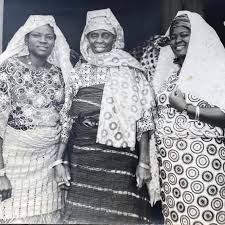
Humuani Amoke Alaga: The Muslim Woman Whose Deeds Redefined Women’s Power in Nigeria
When Nigerian women were largely excluded from formal political spaces in the early twentieth century, Alhaja Humuani…
When Nigerian women were largely excluded from formal political spaces in the early twentieth century, Alhaja Humuani Amoke Alaga carved out power where it was least expected—in the market, on the streets, and within women’s collectives, including the Muslim community.
Through trade, activism, and education, she transformed everyday economic spaces into platforms for resistance and reform, becoming one of Nigeria’s most influential grassroots women leaders. Humuani Amoke Alaga was born in Ibadan, Nigeria, in 1907 into a Muslim family deeply rooted in commerce and scholarship.
Her father, Alfa Aliu Adisa Alaga, was a respected Muslim cleric and trader, while her mother, Asimowu Oladoyinbo Ladebo Anigbalawo, was a successful merchant dealing in textiles and beads. Humuani Amoke Alaga’s life tells the story of how determination, collective action, and visionary leadership can challenge unjust systems and expand opportunities for generations of women.
As the youngest of four children, Alaga was introduced early to the world of trade. She frequently accompanied her parents on business trips to places such as Lagos, Ejigbo, Ogbomosho, and Osogbo, selling beads and textiles and learning negotiation, customer relations, and market dynamics long before formal education was common for girls. These formative experiences laid the groundwork for her future as both an entrepreneur and a leader.
She married at the age of 18 to an Egba man, Sanusi Oshinusi, in 1925. After her marriage, Alaga began her independent business journey by hawking textiles across Ibadan, as she was considered too young to own a shop. Through discipline and careful saving, she steadily expanded her trade. By 1928–1929, she had accumulated enough capital to open her own shop at Gbagi Market, one of Ibadan’s most important commercial centres. This success led to her becoming a dealer for major firms such as G. B. Ollivant, John Holt, and UAC.
Her business success was exceptional for an indigenous woman of her time. In 1934, she was appointed Iya Egbe Alaso, the leader of textile dealers at Gbagi Market. This role placed her at the centre of market administration, conflict resolution, and the representation of women traders’ interests. She was no longer just a trader—Humuani had become a voice. A voice for the voiceless.
Alaga’s leadership soon extended far beyond commerce. She understood that economic independence meant little without justice and fairness, a belief that drove her deep involvement in labour activism. In 1938, she led the Women’s Cotton Trade Union in protests against Lebanese traders whose bulk-buying practices undercut local women’s businesses. Her leadership brought attention to the economic marginalisation of indigenous traders and strengthened women’s collective bargaining power.
Again, in 1953, she led members of the Ibadan African Textile Association in protest against the proposed relocation of Dugbe Market. The women marched barefoot to the palace of the Ibadan monarch—a powerful symbolic act that emphasised humility, determination, and moral authority. The protest succeeded in drawing attention to their demands and protecting their livelihoods.
That same year, she became one of the founders of the Action Group Women’s Wing, working alongside figures such as Tanimowo Ogunlesi, Wuraola Esan, T. T. Solaru, and Chief Hannah Idowu Dideolu Awolowo (HID). In 1958, she built a mosque in Sango and co-founded the Isabatudeen Women’s Society alongside eleven other women. The society focused on women’s welfare, social development, and, most importantly, girls’ education. One of its landmark achievements was the establishment of the Isabatudeen Girls’ Grammar School in 1964.
The school was created to provide Muslim girls with access to quality secondary education that balanced Islamic values with Western academics. Its establishment followed an incident of injustice and humiliation involving Humuani’s daughter, who sought admission to St. Anne’s School, Ibadan. She was reportedly told that she would need to convert from Islam to Christianity before her admission could be considered. In response, Humuani convened a meeting with members of the Isabatudeen Society, which led to the founding of the first all-Muslim girls’ school in Ibadan.
Approval for the school did not come easily. The Western Region government initially refused approval, prompting sustained protests by members of the Isabatudeen Society. Eventually, the new Premier, Samuel Ladoke Akintola, intervened and granted approval. A year later, in 1959, Alaga became one of the founding members of the National Council of Women’s Societies (NCWS), a nationwide umbrella body that unified women’s groups and strengthened women’s voices in national discourse. She was elected president of the NCWS in 1961, and the organisation would go on to become one of Nigeria’s most influential women’s bodies.
Even decades later, her activism did not wane. In 1978, she led market women in a protest at the Oyo State Governor’s Office against the killing of students by soldiers during the “Ali Must Go” protests, reaffirming her lifelong commitment to justice and accountability.
Humuani Amoke Alaga lived a long life defined by service, courage, and community leadership. She passed away on 29 January 1993 in Ibadan at approximately 93 years old. Her legacy lives on through the markets she defended, the institutions she helped build, and the countless women whose lives were shaped by her leadership.
She stands as a reminder that political power does not always begin in government offices; sometimes, it begins in the market—with women who refuse to be silent. Through her advocacy, she challenged discriminatory labour practices, including unequal pay structures that favoured men, and helped improve the lives of women in the civil service. Alhaja Humuani Amoke Alaga was more than a trader or activist; she was a grassroots nation-builder. Through entrepreneurship, labour resistance, and educational advocacy, she reshaped the social and economic realities of women in Nigeria. Her life affirms that sustainable change often comes from those who understand the struggles of the people and choose to stand firmly beside them. Her story deserves to be remembered—not only as history, but as lasting inspiration for women and the Muslim community alike.
Farimah Aderohunmu —KnowIslam Project