Religious Apartheid In Nigeria’s History — Bashir Lucas Samson Lukman
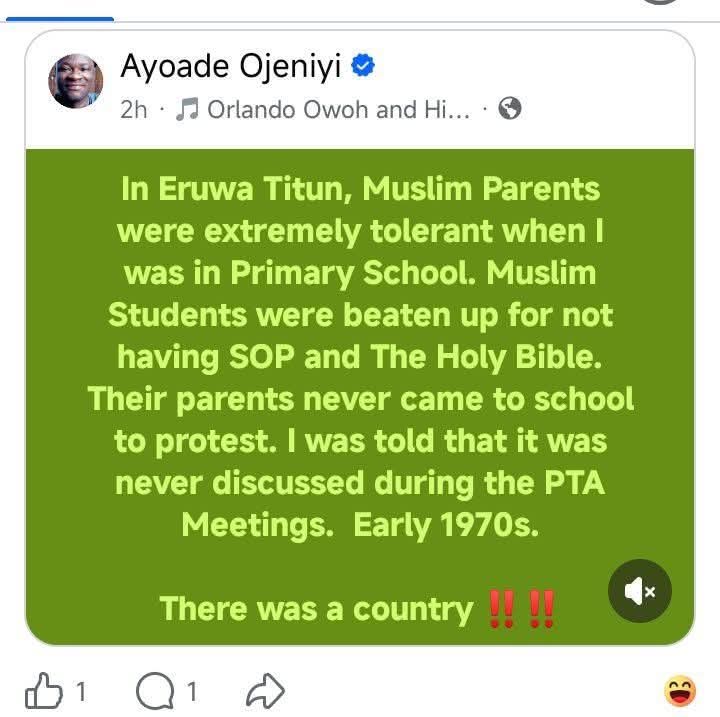
Tolerance? This post from Mr Ayoade Ojeniyi presents a troubling memory from early-1970s framed as an example…
Tolerance?
This post from Mr Ayoade Ojeniyi presents a troubling memory from early-1970s framed as an example of “Muslim tolerance.” According to the account, Muslim pupils were beaten for not owning Christian religious materials, while their parents neither protested nor raised the issue at PTA meetings. This silence is then remembered as proof of Tolerance but that framing is deeply misleading.
What is being described is not tolerance; it is coercion. True tolerance implies freedom of choice—freedom to practice one’s faith without fear, punishment, or exclusion. What happened in many parts of Nigeria during that era, including stories like this one, reflects something else entirely: religious domination backed by institutional power, especially within mission-controlled schools.
Muslim children were not merely “disciplined”; they were pressured to conform. Some were compelled to attend Christian religious instruction, forced to adopt Christian names, or subtly pushed toward conversion just to access basic education. For parents, the choice was cruelly simple: submit, or watch your child be denied schooling altogether. Many parents lacked education themselves, had no political leverage, and lived under systems that gave them little room to resist. Silence, in such circumstances, was not agreement—it was survival.
In fact, some parents did resist. And when they did, their children were withdrawn from schools or never enrolled at all. For these families, preserving faith meant sacrificing formal education. That is not tolerance on either side; that is exclusion enforced by power.
Calling this period “tolerance” romanticizes suffering and erases the imbalance that defined it. It also flips the moral responsibility: it praises the oppressed for enduring injustice quietly, instead of questioning the system that made quiet endurance necessary.
If we are honest, this chapter of Nigeria’s history resembles religious apartheid more than coexistence—a time when access to education was conditioned on religious compliance, and difference was punished rather than accommodated.
This history should not be celebrated. It should be remembered, studied, and acknowledged for what it was, so that modern Nigeria does not repeat it under new disguises. Genuine tolerance is not silence under threat; it is equality without coercion. Anything less is not tolerance—it is oppression wearing a polite name.