The rise and fall of ISIL explained
Three years after Mosul takeover, here is a breakdown of ISIL’s path from its very beginnings to…
Three years after Mosul takeover, here is a breakdown of ISIL’s path from its very beginnings to its current decline.
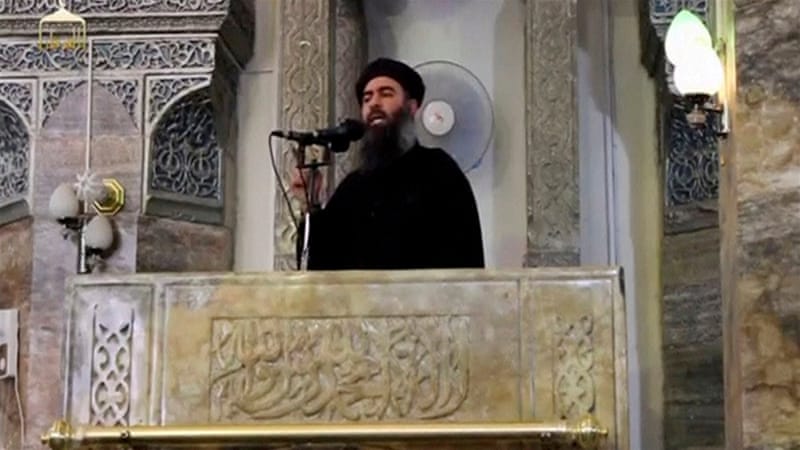
Pushed out from many of its strongholds in Syria and besieged on all sides in the Iraqi city of Mosul, the Islamic State of Iraq and the Levant group (ISIL, also known as ISIS) is losing its territorial base in the very region that once incubated its growth. In May, the US Defense Intelligence Agency estimated that ISIL has lost 65 percent of its land in Iraq and 45 percent in Syria since 2014.
With the group’s presence in the region greatly diminished, questions arise over who will fill the vacuum left by its retreat.
ISIL’s rapid expansion has irrevocably changed the political dynamics governing the region – but in order to know how, one must first understand the conditions that contributed to the group’s rise.
Below, Al Jazeera charts ISIL’s path from its very beginnings to the slow rot of its current decline.
How did ISIL consolidate its power?
Since the 2003 US occupation of Iraq, the Middle East has undergone a roiling period of conflict, rising sectarianism and chaotic regime change. It is in the shadows of this crumbling regional landscape that ISIL first began to metastasize, nourished by the increasing frailty of Arab states in revolt or at war.
Authors, JM Berger and Jessica Stern in, ISIS: The State of Terror, and Fawaz A Gerges in, ISIS: A History, traced the group’s origins to the early-1990s, when a Jordanian man known as Abu Musab al-Zarqawi, a street thug and former prisoner in Jordan, left for Afghanistan to fight as a mujahed against the Soviet occupation.
He arrived in the country too late. The conflict had subsided, but he later returned to Afghanistan from Jordanin 2000 to set up a training camp for fighters with tepid financial support from al-Qaeda.
There, he developed a recruitment network of fighters whose backgrounds often sketched the same lines as his own: Born into poverty, often radicalised in prison, and with low-levels of education and shallow theological knowledge of the Quran.
Zarqawi’s resources were sparse by the time he arrived in a US-occupied Iraq to form a branch of al-Qaeda. Yet mounting sectarian tensions allowed Zarqawi to gain followers and resources for his fanatical organisation.
Iraq is a first example of how Western intervention and failing state services gave way to an environment of raw, divisive resentment that benefited ideologues like Zarqawi.
After Saddam Hussein was removed from power, the US-led transitional coalition embarked on a widespread overhaul of the national government, pruning its ranks of members from Hussein’s Baath party.
The Iraqi military was also disbanded, creating “a bulge of angry, disenfranchised Sunni technocrats” among the population. In their book, Stern and Berger estimate that more than 100,000 Baathists were removed from their posts.
Some of them would be poached by Zarqawi’s organisation and would later fill the higher ranks of ISIL, proffering a wealth of military knowledge that, among some Baathists, extended as far back as the Iraq-Iran war.
As then-Prime Minister Nouri al-Malikipaid hollow lip service to ideas of inclusion while simultaneously employing sectarian-based policies, Zarqawi played on feelings of disaffection in the country’s Sunni communities. With his 2004 establishment of al-Qaeda in Iraq, Zarqawi had the blessing of Osama bin Laden to advance towards a total war against Shia Muslims.
“Zarqawi himself was deeply sectarian, but also saw that provoking Sunni-Shia confrontation would work in his favour,” said Richard Atwood, New York director of the International Crisis Group, whose work focuses on al-Qaeda and ISIL. “He instigated attacks on Shia religious symbols, provoking a sectarian civil war.”
 |
| Zarqawi played on feelings of disaffection in the Iraq’s Sunni communities [Ali Jasim/Reuters] |
Al-Qaeda in Iraq merged with other groups in 2006 and adopted the name the Islamic State in Iraq while still maintaining tenuous ties to al-Qaeda leadership. According to the Wilson Center, on October 15, 2006, Abu Ayyub al-Masri, who took over the group after Zarqawi’s death, announced the establishment of the Islamic State in Iraq (ISI), with Abu Omar al-Baghdadias its leader.
By 2010, divides between Sunni and Shia Muslims were extensive, but left unaddressed by an increasingly authoritarian Maliki who, at that point, had named himself his own interior and defence minister.
The state could no longer provide basic services, such as electricity; powerful Sunni tribes, once promised positions in the government in exchange for cooperating with US occupying forces, were shunted aside.
In 2011, anti-government protests erupted across the country. Security forces cracked down, and the state’s violent response stoked the furore of a wide array of emerging opposition groups.
As ISIL wedged itself into the deepening furrows between Sunni and Shia Muslims, the group also focused its energies on provoking discord within sects. Demonstrating a savvy for identifying long-present tensions, it infiltrated Sunni tribal communities and turned sub-tribes or generations against each other through the selective backing and funding of groups, Atwood explained.
“[ISIL’s] rise was very much rooted in deteriorating Sunni-Shia relations and Maliki’s rule. “ISIL rebuilt underground networks and sleeper cells gradually. Its ranks, including at leadership level, were also reinforced by prison breaks.”
How did ISIL gain power in Syria?
Where hopeful supporters saw potential for change during the 2011 Arab revolutions, ISIL saw a moment of violent disorder that could be leveraged for power. In late 2011, ISIL sent a trusted lieutenant, Abu Mohammed al-Joulani, to set up a cell in Syria.
He established Jabhat al-Nusra, which would gain notoriety in the civil war for its military prowess and extensive use of suicide bombers. For years, al-Nusra hid its affiliation with ISIL and al-Qaeda. They received clandestine support in exchange for sharing its logistical and financial gains with Baghdadi. A study on Jabhat al-Nusra by the Brookings Institute found out that, in 2012, the group still received 50 percent from its funding from ISIL.
In 2013, however, Baghdadi announcedISIL’s link to al-Nusra in defiance of al-Qaeda central and demanded that Joulani annex his group. Joulani refused, prompting a bloody struggle that killed thousands of fighters and demonstrated that ISIL’s ruthlessness extended even to those among its ranks.
Soon, ISIL began building its own independent cell in Syria and proved adept at infiltrating previously rebel-controlled territories.
|
|
“After its split from al-Qaeda, ISIL moved more aggressively into the east and peeled off a lot of fighters from al-Nusra. It then moved aggressively against the rebels instead of attacking the regime,” said Atwood, adding that ISIL nevertheless found staunch resistance from rebels in the northwestern region.
Meanwhile, the Assad regime’s choice to seek support from both Iran and Hezbollah only played into ISIL’s narrative of “defending Sunni interests against Shia dominion”. The Brookings study explains that, “the visible role of Iran and Hezbollah, as well as other smaller Shia militia factions in backing the Assad regime additionally framed the conflict in Syria in the kind of sectarian terms” that could be so easily exploited by ISIL.
By 2014, ISIL had taken Mosul from a defeated Iraqi army, as well as Raqqaand oil-rich Deir Az Zor in Syria.
The group used tools and bulldozers to begin systematically dismantling the Syria-Iraq border, turning its caliphate aspirations into reality.
After establishing its caliphate, how did ISIL maintain control?
After consolidating territorial gains, ISIL began setting up its bureaucratic porto-state with the help of foreign technocrats who travelled to join the group. According to a study by Carnegie Middle East Centre, by attracting foreign recruits, not just to become fighters, but also residents, ISIL would have achieved two goals; increase its population and realise its goal of establishing a lasting state.
These new arrivals would manage a range of sectors that included education, health and community policing. Their contributions helped gird the overarching message of ISIL’s propaganda: come join to be a part of the caliphate future. ISIL didn’t only call for fighters on social media, but also for doctors, engineers and regular citizens who could be swayed into believing they had a role in the group’s vision.
 |
| ISIL began setting up its bureaucratic porto-state with the help of foreign technocrats who travelled to join the group [Reuters] |
The brutal violence ISIL waged on the local populations it controlled has been well-documented, as the group set about extracting profits from the resources and tax base of its “wilayat”, or provinces.
According to this study, ISIL has six major categories of income; Taxes and fees, katural resources, kidnapping, antiquities, foreign donations, looting, confiscations and fine.
In the years since 2014, Islamic State’s annual revenue has declined significantly from up to $1.9b in 2014 to a maximum of $870m in 2016.
What can we expect for the future of the region?
Today, ISIL’s territories are shrinking as its fighters face mounting pressure from a US-led coalition, as well as Syrian President Assad‘s regime backers. Many observers have sounded the coalition attack on Mosul as ISIL’s death knell. However, ISIL will always present tremendous problems for state governments – even in its retreat.
“There is a political crisis in Iraq that no one is resolving,” said Yezid Sayigh, a senior fellow at Carnegie’s Middle East Center.” The real question becomes what, if anything at all, is the Iraqi government doing to produce a new political environment because that will shape how local groups respond to ISIL disappearing.”
Throughout the years, ISIL has both instrumentalised and deepened sectarian anger and distrust towards states in the region. As ISIL loses land, these sentiments will only pose more trouble for governments attempting to rule in the aftermath.
Last year, the Iraqi parliament angered Sunni politicians when it approved a law to legalise the Popular Mobilisation Forces (PMF), an anti-ISIL force composed of various militia fighters. The PMF now operates alongside the Iraqi military forces – an outrageous affront, according to Sunni Iraqis, who accuse the PMF of committing human rights atrocities against civilians.
Furthermore, foreign powers fighting ISIL have brought with them a separate set of difficulties which, in the coming years, will have an immense effect on the political futures of Iraq and Syria.
The fight against ISIL has created a splintering array of groups who hold different interests and benefit from diverse foreign backers. After ISIL, Iraq’s weakened state will be charged with the task of creating a harmonious and inclusive political future among this fragmentation, according to Sayigh.
In Iraq, different anti-ISIL factions and militias may view this moment as an opportunity to assert dominance and may resort to jostling with each other to grab resources or political control. Disagreements are not limited to a simple Shia-Sunni divide, but are also endemic within different militia or political groups of the same sect.
“Everyone tends to fixate on ISIL to the complete neglect of the deeper, wider crisis of the Iraqi political system,” said Sayigh. “There is much competition and refusal to cooperate among different Shia political factions and their military wings.”
Atwood, of the International Crisis Group, echoed a similar sentiment, “One of the dangers now in Mosul is that the groups fighting ISIL, some of which are backed by Iran, some by Turkey and some by the US and all of which have their own competing interests, will contest violently for turf afterwards.”
The spaghetti tangle of different alliances between invested foreign powers has only worsened the situation.
In Syria, plans to route ISIL out of Raqqa have created diplomatic trouble for the US, which is ready to throw in financial and strategic resources to support the Kurdish People’s Protection Units (YPG): A Syrian Kurdish faction fighting ISIL.
Yet the YPG’s close links with the Kurdistan Workers’ Party (PKK), declared a “terrorist” group in Turkey, has angered the Turkish government which nevertheless remains the US’s NATO ally.
|
|
In Iraq, the lead-up to the Mosul attack provoked tensions between Baghdad and the Kurdistan Regional Government, as Arab Iraqis feared that Mosul would give the country’s Kurdsan opportunity to seize territory.
Competing agendas have congealed political systems into stalemates, creating an expansive crisis that could rear its head in Syria’s peace process and in Iraq’s upcoming parliamentarian elections.
Amid this disorder, the future strategy of ISIL is unclear. Having lost territory in the Middle East, could ISIL swing its attention to the West and focus its energies on carrying out attacks there?
“It looks likely that attacks on the West that are claimed and in some cases instigated or supported by ISIL will continue, notwithstanding its losses in Iraq and Syria,” said Atwood.
“That said, the ISIL brand was closely linked to its territorial expansion and self-proclaimed caliphate. With those gone, it will have to redefine success and rebrand,” he added.
Source: Al Jazeera News