
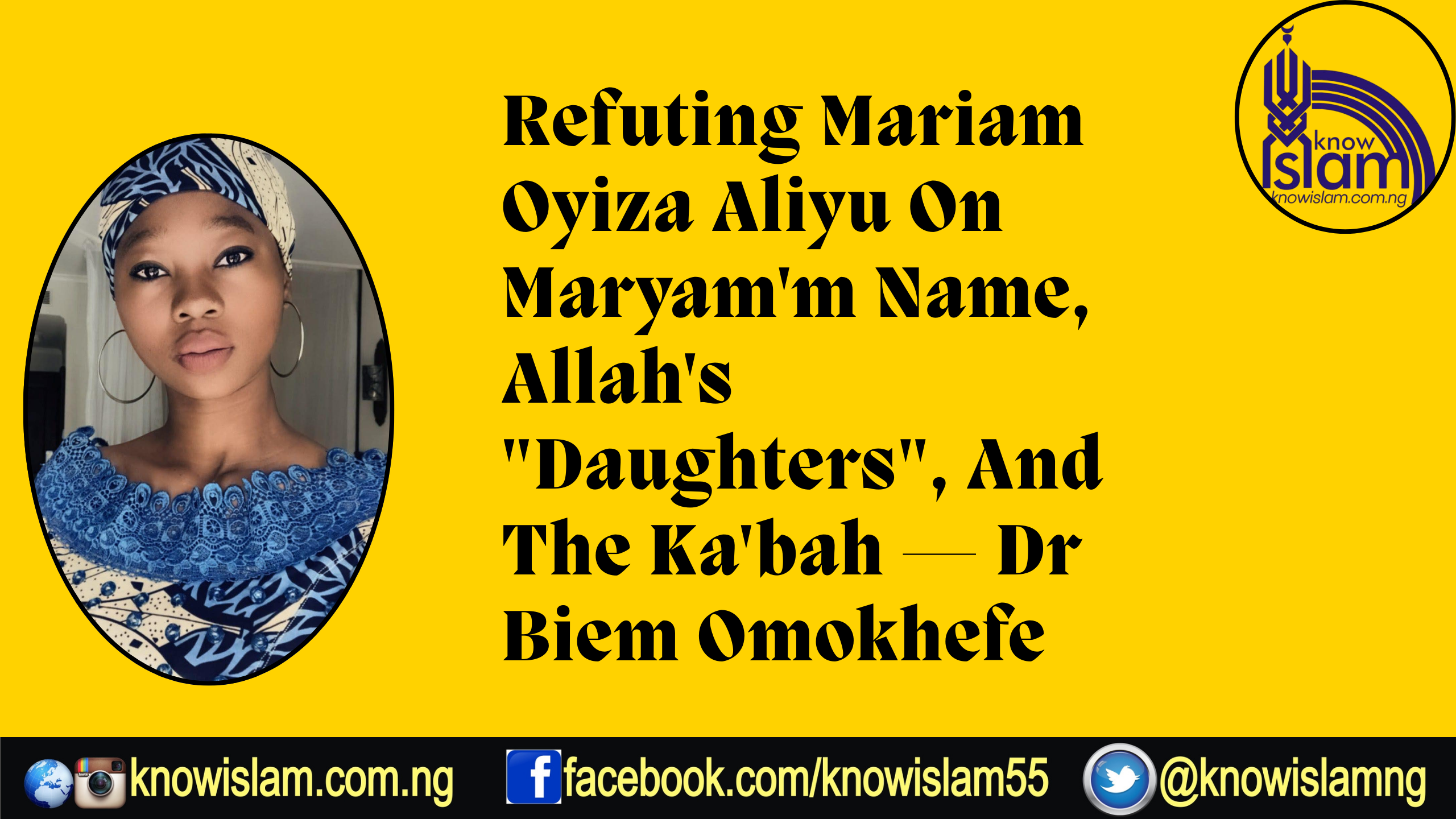
Refuting Mariam Oyiza Aliyu On Maryam’m Name, Allah’s “Daughters”, And The Ka’bah — Dr Biem Omokhefe
Recently, Maryam made several claims about Islam that combine misunderstanding with misrepresentation. Criticism of religion is not…
Recently, Maryam made several claims about Islam that combine misunderstanding with misrepresentation. Criticism of religion is not new, and no one is above scrutiny. However, criticism must be grounded in facts, context, and intellectual honesty, not distortion.
Let us examine some of the claims and correct the misconceptions.
1. The Meaning of Islam
Maryam claims to understand Arabic, yet she misrepresents the meaning of the word Islam.
The word Islam comes from the Arabic root س-ل-م (S-L-M), which carries meanings such as peace, safety, and security. From this root comes the verb aslama, which means to submit or surrender oneself to God.
Thus, Islam means submission to the will of Allah, which leads to peace and security.
The Qur’an emphasizes this idea clearly:
“And Allah invites to the Home of Peace (Dār as-Salām) and guides whom He wills to a straight path.”
(Qur’an 10:25)
Submission to God is therefore not oppression but a path toward peace.
2. The Arabs and the Belief in Allah
It is historically accurate that many pre-Islamic Arabs were polytheists. However, they did not deny the existence of Allah as the Supreme Being.
Even in their polytheism, they recognized Allah as the highest deity but associated other gods with Him. Their error was not denying God’s existence but corrupting the pure monotheism of Abraham by worshipping idols.
The Kaaba itself was not originally built for idol worship. According to Islamic tradition, it was built by Prophet Abraham (Ibrahim) and his son Ishmael (Ismail) as a house dedicated to the worship of the One God.
Islam did not introduce a new religion but restored the original monotheism of Abraham.
3. The Claim That Allah Has Daughters
Some pre-Islamic Arabs believed that certain idols represented the “daughters of Allah.” This belief was strongly rejected and condemned by the Qur’an.
The Qur’an challenges this idea directly:
“Have you considered Al-Lat, Al-‘Uzza, and Manat, the third—the other one? Is the male for you and the female for Him? That, then, is an unjust division.”
(Qur’an 53:19–22)
Another passage further exposes the contradiction in their claims:
“Now ask them: Does your Lord have daughters while they have sons? Or did We create the angels as females while they were witnesses? Indeed, it is out of their falsehood that they say, ‘Allah has begotten,’ and indeed they are liars.”
(Qur’an 37:149–152)
Islam categorically rejects the idea that God has children or partners.
4. Circumambulating the Kaaba
Maryam claims that the practice of circumambulating the Kaaba predates Islam. In this point she is partially correct, but she fails to mention the historical context.
The practice of tawaf (circumambulation of the Kaaba) traces back to the time of Prophet Abraham. Over time, the Arabs corrupted this practice by mixing it with idolatry.
Islam did not invent the practice; it restored it to its original monotheistic purpose.
The Qur’an states:
“Indeed, the first House established for mankind was that at Bakkah, blessed and a guidance for the worlds.”
(Qur’an 3:96)
And regarding its construction:
“And when Abraham and Ishmael were raising the foundations of the House, they prayed: ‘Our Lord, accept this from us…’”
(Qur’an 2:127)
5. The Black Stone
Another common misconception is that Muslims worship the Black Stone.
This claim is incorrect.
The Black Stone (al-Hajar al-Aswad) is a sacred marker placed at the corner of the Kaaba. It is not a deity and is not worshipped.
Muslims kiss or touch it as a symbolic act during pilgrimage, following the example of the Prophet Muhammad ﷺ.
Importantly, when the Black Stone was stolen for nearly twenty years in Islamic history, the pilgrimage continued without interruption, demonstrating that it is not an object of worship.
6. Bowing in Prayer
Maryam claims that Muslims copied bowing from other religions.
In reality, bowing and prostration have always been part of worship in the Abrahamic tradition. These acts represent humility before God.
The Qur’an mentions that such forms of worship were already practiced in connection with the Kaaba:
“And We instructed Abraham and Ishmael, saying: Purify My House for those who perform tawaf, and those who stand, bow, and prostrate.”
(Qur’an 2:125)
This shows that prayer involving bowing (rukūʿ) and prostration (sujūd) existed long before the time of Prophet Muhammad ﷺ.
7. Islam and Previous Religions
Islam did not come to erase earlier revelations. Rather, it came to confirm what was true in previous scriptures and correct later distortions.
The Qur’an does not reject all Jews or Christians. Instead, it calls people back to pure monotheism, ethical conduct, justice, and sincere worship of God.
Criticism and discussion are part of intellectual discourse, and no one is asking Maryam to remain silent. However, spreading misinformation and presenting distorted claims does not contribute to honest dialogue.
If someone wishes to critique Islam, the least they can do is engage with its teachings accurately and responsibly.
As for the name Maryam, it predates Islam and is deeply respected in the Islamic tradition. Maryam (Mary), the mother of Jesus, is one of the most honored women in the Qur’an.
Truth should be pursued with sincerity, not distorted for the sake of argument.