
Refutation To Mariam Oyiza Aliyu’s Criticism of Qur’an 2:190-191, 9:5, 3:151, 9:29 and 47:4 — Biem Omokhefe
Mariam Aliyu, who claims to be an ex-Muslim, recently launched an attack on Islam on Facebook by…
Mariam Aliyu, who claims to be an ex-Muslim, recently launched an attack on Islam on Facebook by citing a series of Qur’anic verses commonly misused by Islamophobes and certain Christian polemicists. Unfortunately, her argument relies on a familiar tactic: quoting verses in isolation while deliberately ignoring their context.
This approach does not represent honest scholarship or sincere criticism. It is intellectual dishonesty.
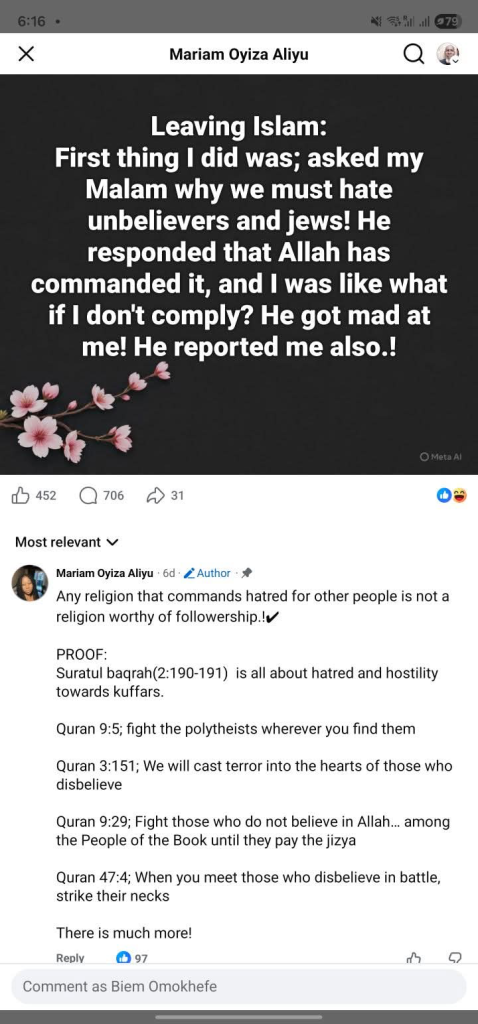
Let us examine the verses she cited.
Qur’an 2:190–191
The verse actually begins with a restriction:
“Fight in the way of Allah those who fight you, but do not transgress. Indeed, Allah does not love transgressors.”
This verse clearly speaks about defensive warfare.
The early Muslims were persecuted in Makkah, tortured, expelled from their homes, and attacked repeatedly. Only after years of oppression did the Qur’an permit them to defend themselves.
Even then, the command came with strict limitations: do not transgress.
Islam therefore permits fighting only as a response to aggression, not as a tool of oppression.
The Qur’an further states:
“Persecution (fitnah) is worse than killing.” (Qur’an 2:217)
Oppression, persecution, and religious tyranny are condemned in Islam.
Qur’an 9:5
This verse is frequently quoted as:
“Fight the polytheists wherever you find them…”
But critics conveniently ignore the verses before and after it.
I challenge Mariam to post the full passage from verse 1 to verse 6 and allow readers to judge for themselves.
The verse addresses specific pagan tribes who violated their peace treaties with the Muslims and launched attacks against them. It is not a universal command against all non-Muslims.
Immediately after this verse, the Qur’an states:
“If any of the polytheists seeks your protection, grant him protection and escort him to a place of safety.” (Qur’an 9:6)
Why is this verse almost never quoted by critics?
Because it destroys the false narrative that Islam commands indiscriminate violence.
Qur’an 3:151
“We will cast terror into the hearts of those who disbelieve…”
This verse refers to the Battle of Uhud, a military confrontation between two armies.
It is absurd to expect an army in battle not to strike fear into its enemies.
Does Mariam believe that soldiers fighting Boko Haram should avoid making the terrorists fear them?
Military strategy naturally aims to weaken enemy morale. If aggressors feel no fear, they simply continue attacking.
The Battle of Uhud itself was not a random conflict. The Meccan forces sought to kill the Prophet Muhammad and eliminate Islam entirely. It was a battle for survival.
Qur’an 9:29
This verse addresses conflict with certain groups that had entered into hostilities with the Muslim state.
It introduced jizya, a tax paid by non-Muslim citizens in exchange for protection and exemption from military service.
Critics present this as oppression, yet historically it functioned as part of a political system. Muslim citizens paid zakat, while non-Muslims paid jizya in place of military obligations.
This was a structured system of governance, not religious persecution.
Qur’an 60:8
Interestingly, Mariam ignored a verse that directly contradicts her narrative.
“Allah does not forbid you from being kind and just toward those who do not fight you because of religion or drive you out of your homes.”
This verse clearly establishes that Muslims must treat peaceful non-Muslims with kindness and justice.
Qur’an 47:4
“When you meet those who disbelieve in battle, strike their necks…”
Again, the verse clearly states “in battle.”
This is a wartime instruction directed at combatants, not civilians.
In war, lethal force is unavoidable. If soldiers do not neutralize their enemies, their enemies will kill them.
Every military in the world operates according to this reality.
The Qur’an’s Broader Message
Critics who cherry-pick verses often ignore the Qur’an’s foundational principles:
• “There is no compulsion in religion.” (2:256)
• “Allah does not forbid you from being kind and just toward those who do not fight you.” (60:8)
These verses demonstrate Islam’s commitment to justice, coexistence, and religious freedom.
No one is asking Mariam Aliyu not to ask questions or criticize Islam. Intellectual discussion is welcome.
But criticism must be honest.
Cherry-picking verses, ignoring context, and distorting history is not scholarship — it is propaganda.
If Mariam truly seeks the truth, she should present the entire Qur’anic passages, not fragments designed to mislead.
