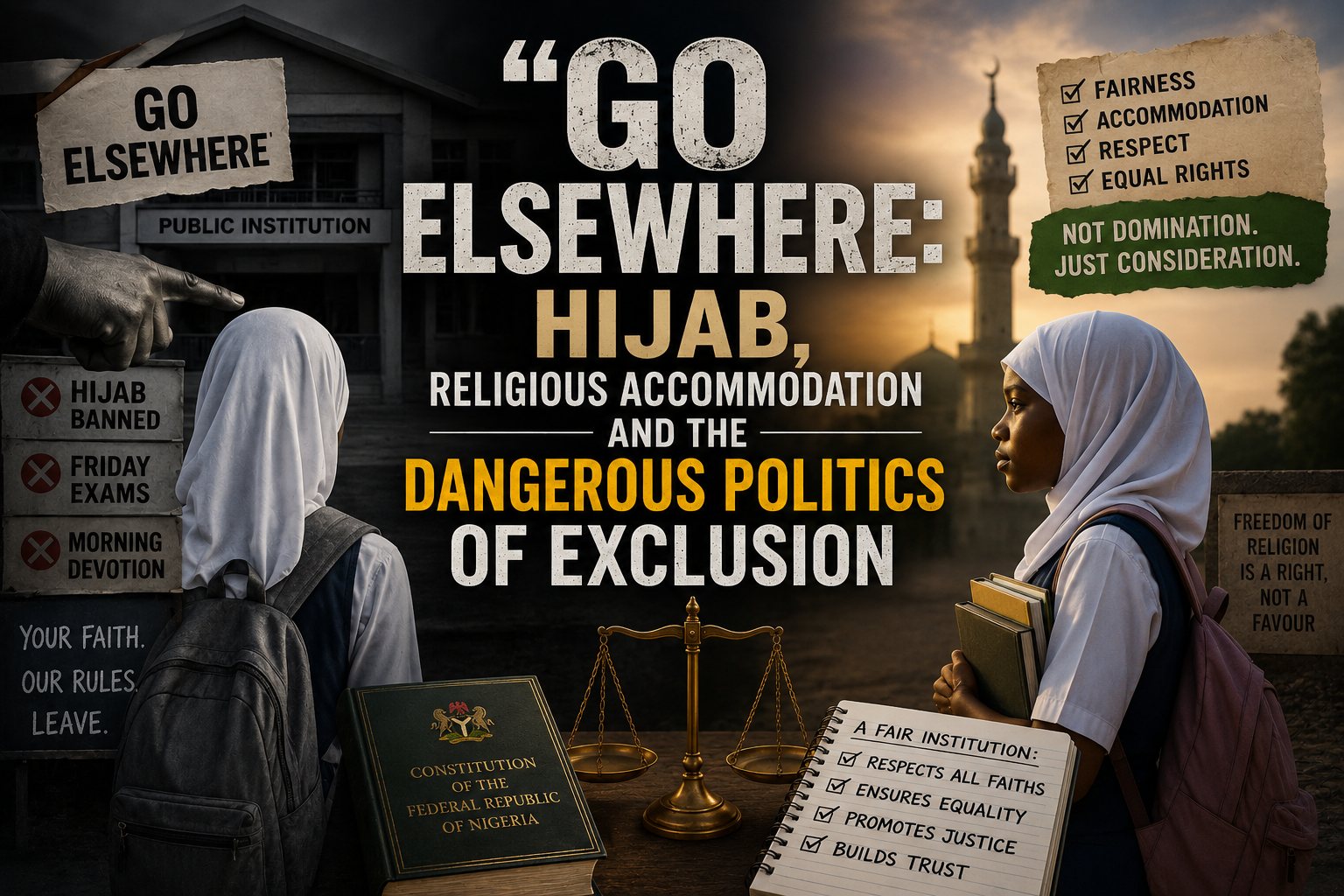
“Go Elsewhere”: Hijab, Religious Accommodation and the Dangerous Politics of Exclusion By Karounwi Adini
The response is becoming increasingly familiar. A Muslim complains that an examination has been scheduled during Jumu’ah….
The response is becoming increasingly familiar.
A Muslim complains that an examination has been scheduled during Jumu’ah.
“Go somewhere else.”
A Muslim student asks to wear the hijab.
“Go to another school.”
Muslim parents challenge a policy they consider discriminatory.
“Why did you bring your child here?”
It is a remarkably convenient argument.
It is also a dangerous one.
At first glance, “go elsewhere” sounds like a defence of institutional autonomy. Look beneath the surface, however, and the logic becomes obvious: if an institution adopts a rule that unnecessarily burdens your religious identity, you should disappear rather than question the rule.
The institution need not explain itself.
The policy need not be examined.
The possibility of reasonable accommodation need not even be considered.
You are the problem.
Leave.
For Nigerian Muslims, this is not an abstract concern.
We have seen enough disputes over the hijab, Jumu’ah, religious activities in public institutions and the treatment of visibly Muslim women to understand where this attitude leads.
Anyone who is a frequent reader of news knows how much Hijab-wearing students and females have faced stiff opposition, moreso from people of their same Yoruba stock.
Nor does it take into account those who use advantage of being in public service to take advantage of it and try and dominate and bully others.
How many exclusive Government secondary schools run morning assemblies devotion.
It was Kadara High School, Lagos where Aisha Alabi was beaten 43 strokes by the Principal U.C Ukpaka for wearing Hijab.
Barira Tajudeen of Mafoluku High School in SS3, was suspended, from pending WAEC exams by the then principal, Elizabeth Omidele, for wearing Hijab.
Olatunji Salau Hawaw was denied an interview at the Federal Medical Centre Ebute-Metta, for wearing Hijab. The National Industrial Court had to describe it as discriminatory.
Olayinka Oladunjoye, the Commissioner of Education, then boldly declared Hijab was banned in Lagos.
In 2015, EKITI SIEC banned Hijab-wearing women from the local elections!
What we have are intolerant people who don’t want to see any Muslim identity in Public schools, Polytechnics, Hospitals and public places, talkless of Private spaces.
Let me now address one pernicious dare being thrown around. “Leave ISI and go elsewhere”. It is an unthinking dare that assumes the grounds they are on is rock solid.
Dr Lateef Adegbite had to intervene in the case of LIAD TELLA, former National Editor of Concord, when he was a student of Baptist High School, Iwo. He, as Attorney- General of Western State, got the Ministry of Education to warn that no student may be compelled to take up a religion other than that of his parents.
UNILAG ISL allows Hijabs according to their regulations and this has never been an issue.
UNILAG however has had 4 Muslims as Vice Chancellors. Saburi Biobaku, Nurudeen Alao, Jelili Omotola, Rahman Ade-Bello.
UI and OAU for example have never had a single Muslim Vice-Chancellor. Since 1948, and 1962.
Even when Professors from these schools have gone on to be VC’s in other Universities.
Do you see how uncomfortable this is going?
Accommodation Is Not Domination
Nigeria is a religiously plural country.
That fact should not be controversial.
Christians live here.
Muslims live here.
Traditional religionists live here.
People with no religious commitments live here.
The responsibility of institutions—particularly public institutions—is not to erase these differences or pretend they do not exist. It is to administer their affairs fairly without unnecessarily placing one religious group at a disadvantage.
This is where the discussion about religious accommodation is often deliberately distorted.
When Muslims ask that a compulsory examination not be fixed squarely within the period of Jumu’ah, the request is presented as an attempt to “Islamise” the institution.
When Muslim girls ask to wear the hijab, it is presented as domination.
When Muslim students ask why a supposedly neutral institution structures its activities around the religious assumptions of others, they are accused of creating trouble.
But accommodation is not domination.
Asking an institution to take your existence into consideration is not the same thing as asking the institution to become Islamic.
A Muslim asking to attend Jumu’ah is not asking Christians to attend Jumu’ah.
A Muslim girl wearing the hijab is not putting a hijab on her Christian classmate.
A Muslim asking not to be compelled into another religion’s devotion is not preventing anyone else from practising Christianity.
This distinction should be elementary.
Yet, somehow, when the person seeking accommodation is Muslim, the mere visibility of his religious identity is often treated as aggression.
We Have Seen This Before
The present hijab controversy did not emerge from nowhere.
For years, Muslim students and women in Nigeria have repeatedly found themselves in disputes over a simple question:
Can a Muslim woman remain visibly Muslim while participating in public life?
Lagos State itself became the centre of a prolonged legal battle over the hijab in public schools.
In 2013, the state’s position against the use of hijab in public schools generated considerable controversy. The matter proceeded through the courts.
The Lagos High Court initially ruled against the Muslim students in 2014.
The Court of Appeal subsequently overturned that position in 2016, holding the restriction discriminatory.
The litigation eventually reached the Supreme Court.
In 2022, the Supreme Court upheld the right of Muslim female students to wear the hijab in Lagos public schools.
Think about that history.
Years of arguments.
Years of litigation.
Years of Muslim girls and their parents being told, directly or indirectly, that their religious clothing was incompatible with the school environment.
And after all of that, the highest court in the country upheld their right in the context of Lagos public schools.
This is why the flippant response of “go elsewhere” deserves scrutiny.
People say it as though Muslims have historically encountered an abundance of institutions eager to accommodate their religious identity.
They have not.
The record tells a more complicated story.
The Hijab Has Repeatedly Become a Battlefield
The problem has never been limited to one school.
In 2015, the Ekiti State Independent Electoral Commission announced that women wearing purdah would not be permitted to vote in the state’s local government elections.
The reason given was identification.
But consider the significance of the policy.
Rather than develop a reasonable identification procedure involving female officials, a category of visibly Muslim women faced exclusion from participation in an election.
This is precisely why religious accommodation matters.
The lazy administrative response is:
“Your religion creates a problem. Remove the religious practice or leave.”
The fairer administrative response is:
“How do we meet the legitimate institutional objective without unnecessarily excluding you?”
These are two entirely different philosophies of governance.
The same tension has appeared repeatedly around the hijab.
In Lagos, Muslim students went through the courts.
At the Nigerian Law School, Firdaus Amasa’s refusal to remove her hijab generated a national controversy after she was initially prevented from being called to the Bar.
Muslim candidates have complained of harassment over the hijab at examination centres.
As recently as the 2026 UTME, the Association of Nigerian Imams publicly condemned alleged harassment of hijab-wearing candidates at some centres.
These incidents should make one fact obvious.
When Muslims say the issue is larger than one school, they are not inventing history.
And Now, ISI
The dispute at the International School, University of Ibadan, has again brought these questions to the surface.
The legal position must be stated carefully.
In 2024, an Oyo State High Court ruled in favour of Muslim students seeking to wear the hijab at ISI.
On 3 July 2026, the Court of Appeal in Ibadan overturned that decision by a majority of two to one.
The majority held that the Supreme Court’s 2022 hijab decision concerning Lagos public schools did not automatically apply to ISI, which the court treated as a private institution.
The Muslim parents involved have indicated their intention to continue the legal challenge.
The litigation is therefore a legal dispute concerning the status of the institution, the application of constitutional religious rights and the scope of school regulations.
These questions will continue to be argued by lawyers.
But there is a broader social argument taking place outside the courtroom.
It is the dare:
“If you want hijab, leave ISI and go elsewhere.”
That argument is more dangerous than the people repeating it appear to understand.
“Go Elsewhere” Is Not a Serious Answer
Let us test the principle.
If an institution can impose a rule that burdens a person’s religious practice and the only response permitted is “leave,” what exactly limits the principle?
If a Muslim student objects to compulsory Christian devotion, should he leave?
If a Christian student enters an institution dominated administratively by Muslims and is subjected to an Islamic religious activity, should she leave?
If an examination is repeatedly fixed during an important period of worship for one religious group, should every member of that group simply find another institution?
At what point do we ask whether the institution itself is acting fairly?
This is the part defenders of the “go elsewhere” argument avoid.
They treat institutional rules as though they descend from heaven.
They do not.
Rules are written by human beings.
Timetables are designed by human beings.
Uniform policies are designed by human beings.
Morning assemblies are organised by human beings.
And human beings have biases, assumptions and blind spots.
A policy can appear “neutral” to the people who designed it simply because the policy reflects their own way of life.
Sunday is an obvious rest day when Sunday is your day of worship.
A Friday afternoon examination creates no religious difficulty when Jumu’ah is not your concern.
A ban on head coverings appears trivial when your religion does not require you to cover your hair.
A Christian devotion at assembly can feel “normal” when Christianity is your religion.
This is why fairness requires more than telling minorities to obey whatever the majority has normalised.
Religious Neutrality Must Actually Be Neutral
How many government secondary schools conduct morning assemblies containing religious devotion?
How many institutions have inherited practices rooted in Christian missionary traditions and simply continued them as though they were religiously neutral?
The question is not whether Christianity should disappear from Nigeria.
It should not.
Christians have the right to practise their religion.
The question is whether a practice remains “neutral” merely because Nigerians have become accustomed to it.
Muslims are frequently told that visible Islamic identity is an intrusion into supposedly neutral spaces.
The hijab is “bringing religion into school.”
Jumu’ah accommodation is “bringing religion into examinations.”
A Muslim society organising students is “bringing religion onto campus.”
But somehow, religious practices inherited from Christian institutional culture can become invisible through familiarity.
They are no longer perceived as religious.
They are simply “the way things are done.”
This double standard is precisely what creates resentment.
Be Careful What You Normalise
There is another reason the “go elsewhere” dare is intellectually reckless.
When people lose confidence that administrators will exercise authority without religious or ethnic prejudice, they begin demanding representation as protection.
They begin counting appointments.
How many Muslims?
How many Christians?
How many Northerners?
How many Southerners?
How many people from my ethnic group?
How many from yours?
This is not always because people enjoy quota politics.
Sometimes it is because they no longer trust “merit” or “institutional autonomy” to operate without prejudice.
If every dispute involving a minority is answered with:
“We control the institution. Leave if you don’t like it,”
do not be surprised when minorities begin demanding a share of institutional control.
If people cannot trust administrators to separate personal prejudice from official functions, they will naturally begin to scrutinise the religious and ethnic identities of those administrators.
Then every appointment becomes political.
Every vice-chancellorship becomes a religious calculation.
Every board becomes a demographic contest.
Every civil-service position becomes a quota debate.
And suddenly, the same people who spent years telling others to “go elsewhere” begin complaining that society has become obsessed with representation.
You cannot repeatedly teach people that identity determines how fairly institutions will treat them and then complain when they begin counting identities.
This Is How Trust Is Destroyed
The better society is not one in which Muslims dominate Christians.
Nor is it one in which Christians dominate Muslims.
The answer to discrimination against Muslims is not discrimination against Christians.
The answer is institutional fairness.
A Christian should not have to fear that a Muslim administrator will use public authority to impose Islam upon her.
A Muslim should not have to fear that a Christian administrator will use institutional regulations to erase his religious identity.
The law should protect both.
Institutional policy should respect both.
And where reasonable accommodation can be made without destroying the legitimate purpose of an institution, accommodation should not be treated as surrender.
The hijab does not prevent a student from learning mathematics.
It does not prevent her from studying chemistry.
It does not prevent her from writing English examinations.
A carefully designed timetable that considers Jumu’ah does not convert a school to Islam.
Allowing a Christian to attend church does not Christianise a public institution.
This should not be difficult.
Before You Say “Go Elsewhere”
So, before casually telling Muslims to “leave ISI and go elsewhere,” consider the principle you are defending.
Today, you may control the institution.
Tomorrow, someone else may control it.
Today, the regulation may burden a Muslim.
Tomorrow, a regulation may burden a Christian.
Would “go elsewhere” suddenly become an inadequate answer?
Would you then discover freedom of religion?
Would you then remember constitutional rights?
Would you then begin to speak about persecution and discrimination?
Principles are tested by whether we are willing to apply them when the person seeking protection is not one of us.
Muslims should oppose the coercion of Christians.
Christians should oppose the unfair treatment of Muslims.
And public institutions, especially, should never become instruments through which administrators settle religious anxieties.
The question is bigger than the hijab.
It is bigger than ISI.
It is about whether Nigerians can trust institutions to exercise power fairly in a deeply plural society.
Because once that trust disappears, people stop asking whether an administrator is competent.
They start asking whether he is Muslim or Christian.
They stop asking whether an appointment is deserved.
They start counting religious identities.
They stop trusting institutions.
They demand quotas.
And then we wonder how we arrived there.
Sometimes, it begins with something as simple—and as reckless—as a dare:
“If you don’t like it, go elsewhere.”